Eli Turner woke before sunrise, the kind of quiet mountain morning that felt earned rather than given. The cabin was still, the air cool, and the smell of pine drifted faintly through the cracked window. He poured a cup of coffee and spread a folded topographic map across the table, smoothing its creases with the flat of his hand. It had become a ritual over the years. Find a trail. Pick a ridge. Follow the land.
His eyes moved across familiar names until one stopped him.
Teddys Peak.
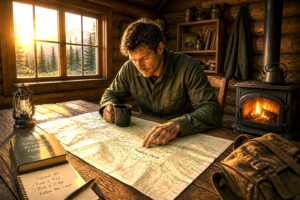 He leaned closer, studying it. The name felt different from the others. It was not descriptive like Bear Lake or technical like Trinchera Peak. It felt personal. Informal. Almost out of place.
“Who was Teddy?” he said quietly.
He traced the contour lines rising toward the summit, then sat back. That was the one. No debate. No second choice.
An hour later, his Subaru wound its way along the narrow road toward the trailhead. The Sangre de Cristo range stretched ahead of him, catching the early light. The peak itself rose steady and quiet above the valley, already holding the sun while the lower ground remained in shadow.
When he arrived, he stepped out, stretched, and took a long breath of cool mountain air. The trail began just beyond a stand of trees, but something else caught his eye first.
Off to the side, half-hidden in the trees, stood an old outhouse.
It leaned slightly, its weathered boards faded gray, its door hanging unevenly on rusted hinges. There was no roof, only open sky framed by broken beams. It looked like it had been standing there for decades, quietly enduring the seasons.
Eli smiled to himself. “Well, that’s something you don’t see every day.”
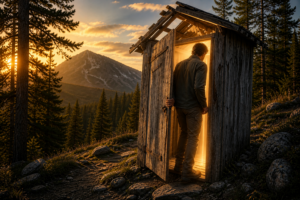 He walked over, more curious than cautious. The wood felt soft beneath his hand, worn smooth in places. Granite fragments lay scattered at its base, matching the stone higher on the mountain. It felt rooted, not abandoned.
The breeze shifted. The air cooled just enough to make him notice. When he glanced back, the light in the clearing seemed sharper.
The door, which had been slightly open, was now closed.
Eli frowned. He was certain it had not been.
He stepped forward, grasped the handle, and pulled.
A rush of wind pushed past him, carrying the scent of dust, paper, and something older. Before he could think it through, he stepped inside.
The world shifted.
A President in the Crowd
The first thing Eli noticed was the noise.
It pressed in from every direction, a swell of voices layered with excitement and movement. He stood in the middle of a crowd, shoulder to shoulder with people craning their necks and rising onto their toes. Eli spotted the Capitol Building in Denver, his curiosity sharpening at the familiar landmark. Yet his chest tightened as he stood swallowed in the restless surge of 30,000 people pressing the steps. It was a scale far beyond Cuchara, where even the largest gathering he had known barely reached a hundred. The crowd both drew him in and unsettled him at the same time.
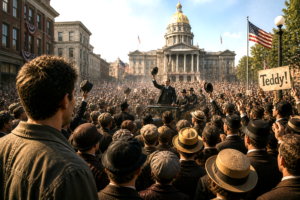 The air buzzed with anticipation.
“Here he comes!”
Eli turned just as a carriage passed, and there he was. Theodore Roosevelt stood upright, hat in hand, his presence unmistakable. He was smaller than Eli expected, but the energy around him made him seem larger than the street itself.
The crowd surged forward, cheering, calling out.
“Teddy!”
The name rolled through the air again and again, familiar, effortless, spoken as if everyone had known him their entire lives.
Eli watched the faces around him. Some were lit with admiration. Others studied him more cautiously. A man nearby shook his head and muttered, “He’s going to lock up half the West if he has his way.”
Another man answered without looking away from the procession. “Maybe that’s what it needs.”
Roosevelt moved through the crowd with a kind of restless energy, acknowledging people, speaking briefly, always in motion. He did not feel distant. He felt immediate, present, and deeply connected to the land he spoke about.
Eli felt himself pulled into the moment, caught between admiration and uncertainty. This was not just a president. This was a force.
The cheers faded as the procession moved on, but the name lingered.
Teddy.
The wind shifted.
The Midnight Decision
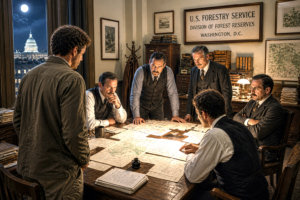 The noise gave way to tension.
Eli now stood at the edge of a rough gathering of men, a mix of government field men and local ranchers, their voices lower, sharper. Papers were spread across a table, weighted down with stones. A lantern flickered in the dim light.
“They’re pushing it through tonight,” one man said.
Another shook his head. “Congress will shut it down if they wait.”
“They know that. That’s why it’s happening now.”
Eli stepped closer, listening.
“Las Animas Forest,” someone said, tapping the paper. “All of it. Locked up in one move.”
There was frustration in the air, but also something else. Recognition.
“He doesn’t back down,” another voice said. “Never has.”
Eli did not need to ask who they meant. Roosevelt’s presence carried into the conversation even in his absence.
This was the moment. The urgency. The decision that would shape the land beneath Teddys Peak long before it carried that name.
One man leaned back and let out a breath. “You may not like it, but he believes in it.”
Another answered quietly, “That’s the problem. He always does.”
Eli looked out toward the dark outline of the mountains. The land was being defined in real time, not by quiet agreement, but by conviction, resistance, and persistence.
The wind rose again, carrying the faint smell of pine.
A Decision in Washington
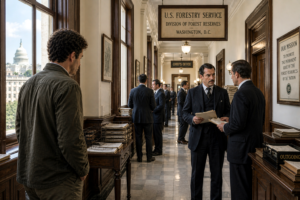 The air changed again, this time carrying the muted sounds of footsteps on polished floors and voices echoing off high ceilings.
Eli stood in a corridor lined with tall windows. Papers moved from hand to hand. Conversations were measured, deliberate.
Two men stood nearby, speaking in low tones.
“It’s the logical step,” one said. “Consolidate it. Bring Las Animas into San Isabel. Simplify the management.”
The other hesitated. “And Roosevelt?”
The first man gave a small, tight smile. “Roosevelt’s day has passed. He’s not the one signing this anymore.”
The name hung in the air, heavier now.
Eli recognized the shift immediately. Roosevelt’s energy, so immediate in Colorado, felt distant here. Reduced to discussion. Interpreted. Managed.
“William Howard Taft wants stability,” the man continued. “Not spectacle.”
“And the conservationists?”
“They’ll be satisfied enough.”
Satisfied enough.
Eli felt the weight of it. The land that Roosevelt had fought to protect was now being reshaped again, not through urgency, but through balance, compromise, and politics.
The mountain remained far away, untouched by the conversation, yet entirely shaped by it.
The wind pressed softly against the windows.
The Name That Stayed
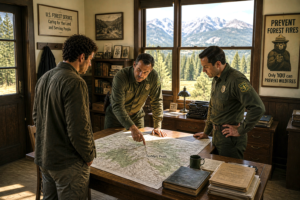 The next shift was quieter.
Eli stood inside a small ranger station. A wooden table sat at the center, a map spread across it. A man leaned over the paper, tracing a line with his finger.
“Teddys Peak,” he said.
Another man nodded. “Been called that for years now.”
“Any idea who Teddy was?”
The first man shook his head. “No record. Just the name.”
Eli stepped closer. The label was clear. Teddys Peak. No apostrophe. No explanation. Just a name, accepted and used.
It matched what the historical record shows, where the name appears on mid-twentieth-century maps without a documented origin and reflects established local usage rather than a formal naming decision.
“Does it matter?” the second man asked.
The first paused, then smiled faintly. “No. But it fits.”
Eli looked down at the map, then out the window toward the distant ridge. The name had outlasted explanation. It had moved from conversation to memory to map without ever being formally defined.
The wind stirred the edges of the paper. He could feel the pull of time calling him back.
What the Mountain Keeps
Eli stepped out of the outhouse and back into the clearing.
The forest was quiet again. His Subaru sat where he had left it. Nothing had changed.
And yet everything had.
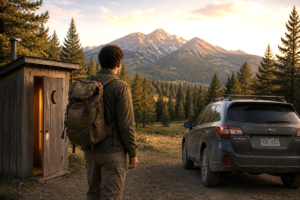 He walked a few steps forward and looked toward Teddys Peak. The summit caught the late afternoon light, holding it for a moment before letting it fade.
He thought about what he had seen.
A president whose name filled the streets and carried across a state. A moment of urgency that tied that name to the land. Decisions made far from the mountain that shaped its boundaries. And finally, a name that remained, not because it was recorded, but because it was used.
He had not witnessed the moment the mountain was named.
He had witnessed something more important.
How a name becomes inevitable.
Roosevelt’s presence made it familiar. His actions tied it to the land. People carried it forward. Mapmakers wrote down what already existed.
Eli let out a slow breath.
“Teddys Peak,” he said quietly.
The wind moved gently through the trees, steady and familiar now.
He turned toward the trail and began his hike, no longer searching for an answer, but carrying an understanding.
The mountain remained.
And somehow, that was enough.
Footnotes
* Authors Note: Time-slip fiction, as used in the Cabin in the Pines blog, is a form of historical storytelling in which a modern character, Eli Turner, travels between eras through an old mountain outhouse that serves as a portal in time. Each journey uncovers the people, geology, and folklore that have shaped the Cuchara Valley across the centuries.
These stories are distinct from the blog’s fact-based historical pieces by their titles, which begin with the words “The Outhouse at the …” Though fictional in form, each tale is rooted in authentic history — blending real people, places, and events with creative imagination to bring the valley’s past vividly to life.