History and Happenings of Pinehaven in Cuchara, Colorado
Methodology, Sources, and Use of Research Tools
What goes on behind the scenes to ensure the history you’re reading is accurate, well-sourced, and trustworthy? We’re glad you asked.
In creating this blog, the author works diligently to conduct careful historical research, track down archival documents and period sources, and verify details with individuals who know this history best. Whenever possible, original records, contemporary newspapers, public documents, and firsthand accounts are consulted to ground each article in verifiable evidence.
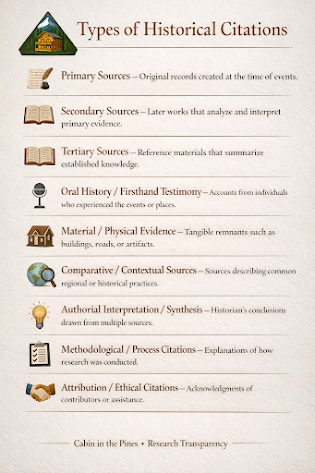
To provide clarity and credibility, footnotes and source references are included at the end of each post. These citations are offered both to document the basis for historical claims and to give readers the opportunity to explore the topics further, review original sources, and draw their own conclusions. In addition, the blog intentionally draws on multiple layers of authoritative sources, as outlined in the accompanying graphic.
As part of the research and writing process, the author also makes limited use of modern digital tools, including AI-assisted technologies. These tools are used in support roles such as research assistance, proofreading, fact-checking prompts, and stylistic refinement. They help surface potential sources, improve clarity, and identify areas requiring closer review, but they do not determine historical conclusions.
All narrative choices, analysis, synthesis of evidence, and historical interpretations are made by the author. Responsibility for accuracy, context, and any remaining errors rests solely with the author.
This approach reflects a commitment to transparency, accuracy, and responsible historical documentation while acknowledging the role that contemporary tools can play in supporting modern research and writing.
Through careful investigation and evidence-based research, Cabin in the Pines has helped bring new clarity to the history of the Cuchara Valley. Among the most significant findings:
- Long-standing references to George Mayes as a physician have been corrected. Documentary evidence confirms that it was his brother, Walter Mayes, who was the trained doctor, restoring accuracy to an often-repeated detail in local history. More here.
- The origins of Cuchara Camps have been clarified. Rather than purchasing the Gould Ranch from W. J. Gould in 1906, records show that George Mayes acquired the property in 1910 from Charles M. Mack through a private financing agreement. This revision reshapes the timeline of one of the valley’s foundational enterprises. More here.
- The discovery of the original dated bill of sale for the Ford Model TT truck used by Mayes as a mobile advertising platform provides rare physical documentation. This finding elevates the truck from anecdotal curiosity to a verified historical artifact tied directly to the promotion of Cuchara Camps. More here.
- The convergence of facts supports an informed interpretation that Teddys Peak was named in honor of Theodore Roosevelt, adding important context to the cultural and historical landscape of the region. More here.
Taken together, these discoveries do more than correct isolated details. They strengthen the integrity of the historical record, offering a clearer, more complete understanding of Cuchara Valley’s past.
At the same time, historical understanding evolves as new sources, technologies, and research methods make additional evidence available. If readers are aware of newly available or previously inaccessible documentary, photographic, or firsthand evidence relevant to this blog, the author welcomes such material for review and possible incorporation in future updates. Revision is one of the most important advantages of a digital format.
Gene Roncone
Curator, Cabin in the Pines Blog