
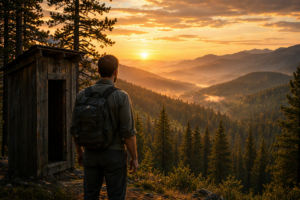
 Eli Turner had stood at this overlook enough times to know when something felt different. Nothing in the landscape announced it. The same ridgelines rolled outward in layered greens, the same early light stretched across the treetops, and the same quiet rested over the valley like a held breath. To anyone else, it would have looked unchanged.
Land never told a simple story. It held memory, pressure, and decisions that lingered long after the moment had passed. And this morning, something beneath the surface felt unsettled, as if the forest itself carried a tension he could not yet name.
He shifted his weight slightly, resting his hands on the straps of his pack as he studied the slopes. The forest stretched for miles, dense and continuous, a living system that felt permanent. It was easy to believe it had always been this way. Eli knew better.
He turned slowly and looked back down the trail. The outhouse stood just beyond the bend, half-shadowed beneath a stand of tall pines. Most hikers passed it without a second glance. It leaned slightly, its boards weathered to a soft gray that blended into the forest. It was easy to dismiss.
Unless you knew what it was.
Eli walked toward it with the familiarity of someone returning to a question that had not yet given up its answer. He had stepped through that doorway before. Not often. Not predictably. But enough to recognize the pattern. Something in the land would shift first. Then the invitation would follow. He stopped at the door and rested his hand on the handle. “Alright,” he said quietly. “Let’s see what this one’s about.”
He pulled it open and stepped inside. The shift came immediately.
A Decision That Changed the Land
 The light dimmed, not as if a cloud had passed overhead, but as if the air itself had thickened. The scent changed too. Pine and earth gave way to something older. Ink. Paper. Oil.
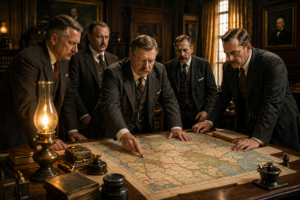
When Eli stepped from the outhouse, the forest was gone. Even though darkness pressed in outside, he stood in a room alive with motion. Maps covered a long wooden table, their edges curling beneath the weight of documents, rulers, and glass ink bottles. Men moved around them in tight, purposeful motions. Their voices were controlled, but urgency ran beneath every word. The room moved in quiet rhythm—papers shifting, pencils marking, decisions taking shape. Eli stayed still, watching.
At the center of the room stood Theodore Roosevelt. He was not as Eli had imagined him. Not theatrical. Not larger than life. There was no need for that. His presence did not dominate the room. It steadied it. Every movement, every word, seemed anchored in something deeper than authority.
Nearby, a staff member leaned toward Gifford Pinchot and spoke just above a whisper. “Why now? Why push this so late into the night?” Pinchot paused, then answered with calm certainty. “Because time is no longer on our side.” He gestured toward the maps spread wide across the table. “The President has four days before Congress removes his authority to create new forest reserves.”
The words settled into the room without raising its volume, but everything seemed to tighten around them. “Four days,” Pinchot repeated softly. “So we move tonight.” Eli felt it then. Not just urgency, but a narrowing. A closing window.
“We do not have the luxury of delay,” Roosevelt said, his voice calm but firm. “If Congress acts first, this opportunity is gone.” A man beside him leaned forward, pointing to a section of the map where boundaries had been extended in long, decisive lines. “They will call it an overreach.” Roosevelt did not look up. “They will call it something worse if we leave it unprotected.”
The room quieted for a moment.
Eli stepped closer, drawn toward the map. He could see the scale now. Vast sections of land, connected and expanded into something far larger than what had existed before. Forest reserves were not being discussed. New ones were rising into existence while existing reserves stretched outward in vast, sweeping expansions.
Another man spoke, his tone measured. “Once these are signed, there is no reversing it.” Roosevelt paused, then nodded slightly. “That is precisely the point.” He reached for the pen.
Eli felt something shift inside him as he watched. Not a surge of emotion. Not even surprise. It was recognition. History did not always arrive with spectacle. Sometimes it happened quietly, in rooms like this, in decisions that lasted only minutes but shaped everything that followed.
Roosevelt signed the document.
The sound of the pen moving across paper seemed louder than it should have been. It carried weight. Finality. And somewhere far away, in a forest Eli had just been standing in, something changed. The room flickered. The scent of ink faded. The light shifted.
What Might Have Been Lost
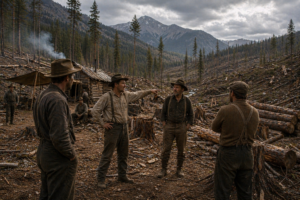 Eli stumbled forward, bursting out of the outhouse into bright sunlight, but the forest waiting for him was no longer the one he knew. The trees were thinner, scattered across uneven ground. The soil was exposed in places, cut through with ruts and broken branches. Stumps stood where trunks had once risen, their rings exposed like open records of time.
The air carried the sharp scent of fresh-cut wood. Voices drifted across the clearing. “You hear about this?” one man said, his tone edged with frustration. “Government says we cannot touch half this land anymore.” Another man shook his head, wiping sweat from his brow. “Easy for them to say. They are not the ones making a living out here.”
Eli moved slowly, listening.
A third man stood apart from the others. Older. Quieter. His eyes moved across the hillside, not just seeing what was there, but what was no longer there. “This will not last,” he said finally. The others turned toward him. “You cut like this long enough,” he continued, “there will not be anything left worth arguing about.” No one answered.
The wind moved through the clearing, carrying dust and the faint echo of something unfinished. Eli looked up toward the ridgeline. It was the same mountain. The same place. But it felt fragile. Exposed. For the first time, he saw the forest not as something inevitable, but as something that had nearly taken a different path.
The moment held, suspended between possibility and consequence. He moved toward the outhouse, and the instant he crossed the threshold, the air changed.
A Different Kind of Decision
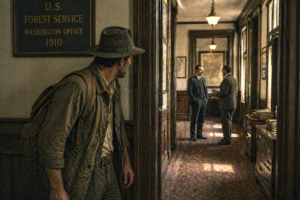 The scent of cut wood faded, replaced by something cleaner, quieter. Footsteps echoed faintly. Papers moved in measured rhythm. The energy here was different. Less urgent. More controlled.
Eli stood in a corridor lined with tall windows, the light filtered through glass and distance. Voices carried in low tones, deliberate and careful. Two men stood nearby, speaking in conversation that felt less like reaction and more like calculation.
“It is the logical step,” one said. “Bring Las Animas into San Isabel. Consolidation will simplify everything. It also allows us to return portions of that land to public domain.” The other hesitated slightly. “And what of Roosevelt?” The first man gave a restrained smile. “Colonel Roosevelt governed by urgency, while President Taft believes there is a difference between conservation and haste. We are now responsible for managing what has already been set aside in those final Midnight Forest proclamations.”
The name hung there, no longer charged with the same energy Eli had felt before. “Taft is looking for stability,” the man continued. “Not expansion. Not urgency.” “And the conservationists?” the other asked. “They will accept it. It is close enough.” Close enough.
Eli felt the difference settle in. Roosevelt’s moment had been driven by conviction and urgency. This one was shaped by balance, compromise, and the need to steady what had already been set in motion. The land was still being shaped. Just differently. The mountain remained far away, untouched by the conversation, yet entirely defined by it.
The Forest That Was Chosen
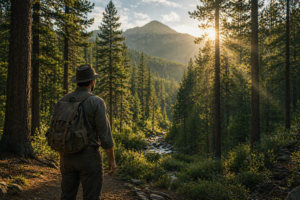 The air shifted once more, softer now, familiar. Eli stepped out of the outhouse and into the clearing. The forest stood whole again. Dense. Continuous. Alive.
He walked slowly back toward the overlook, his steps quieter now, more deliberate. The ridgelines opened before him just as they had before. The same light. The same endless green.
But now, layered within it, he could see something else. Not just what was there, but what had nearly been lost. The stumps. The clearing. The uncertainty. Gone. Not by chance. By decision.
Eli exhaled slowly, the realization settling into place. The forest had not simply endured. It had been chosen. Protected in a narrow window of time by people who understood what was at stake, even when others did not.
Somewhere, in a room filled with maps and urgency, a moment had passed. A small one, measured in hours. And yet it had stretched forward across generations.
Eli turned and looked back at the outhouse one last time. It stood quiet and unchanged, as if none of it had happened. But he knew better.
He adjusted the straps on his pack and stepped onto the trail, beginning the hike down through a forest that now felt different. Not because it had changed, but because he had seen the choice behind it.
The forest had not simply survived. It had been decided. And in doing so, it made it feel even more alive.
Footnotes
* Authors Note: Time-slip fiction, as used in the Cabin in the Pines blog, is a form of historical storytelling in which a modern character, Eli Turner, travels between eras through an old mountain outhouse that serves as a portal in time. Each journey uncovers the people, geology, and folklore that have shaped the Cuchara Valley across the centuries.
These stories are distinct from the blog’s fact-based historical pieces by their titles, which begin with the words “The Outhouse at the …” Though fictional in form, each tale is rooted in authentic history — blending real people, places, and events with creative imagination to bring the valley’s past vividly to life.