Long before we came to live, work, and play in the Cuchara Valley, others risked their lives to make this mountain community possible. We drive paved roads through steep mountain terrain, hike forest trails, summit the valley’s peaks, and enjoy access to lakes, campgrounds, and public lands. Over time, these features begin to feel as though they have always been part of the landscape.
They have not.
Behind nearly every road, trail, firebreak, drainage crossing, and forest facility is the labor of someone who surveyed the route, moved the earth, cleared the trees, operated the machinery, or returned year after year to maintain what others enjoyed. Much of that work was difficult. Some of it was dangerous. In at least one case remembered in the Cuchara Valley, it was fatal.
His name was Elden Falk.
.
Trailblazing Tragedy
.
I first encountered Elden Falk through a Facebook discussion thread by his granddaughter. Her words carried the hint of a larger story: “My grandfather worked for the Forest Service in San Isabel National Forest. My mother and siblings, the 1950s generation, raised us wild in those mountains.”(1)
I had just finished writing about Lewis Cummings, La Veta’s legendary Forest Ranger of the 1950s, and wondered whether she might be describing him. When I reached out, I discovered that her grandfather was someone else entirely: Elden Falk, a younger colleague of Cummings whose name I remembered from his memoirs. Then came the detail that changed everything. Falk had died while serving in the mountains. That single revelation opened the door to a story I could not leave unexplored.
 Elden Falk was born in La Veta in May 1927.(2) After serving during the Second World War, he returned home, reentered La Veta High School, and rejoined the football team.(3) By 1952, Falk was co-owner of the B&F Garage, evidence that mechanical work was already part of his experience before his documented assignments in the mountains.(4)
Falk eventually became associated with San Isabel National Forest field operations in the La Veta and Cuchara area. In 1954, he accompanied Ranger Lewis A. Cummings to Blue Lake, where they measured 25.7 inches of snow containing 6.6 inches of water.(5) Elden Falk also appears in an out-of-print history of the San Isabel National Forest as the supervisor of a demanding 1955 insect-control operation in the remote Huerfano backcountry. From June 13 through July 29, his crew relied on pack horses to haul insecticide into scattered mountain drainages, where they treated approximately 1,350 damaged trees across rugged and difficult terrain.(6)
Such assignments often took forest workers deep into isolated mountain country, where steep slopes, sudden storms, primitive equipment, unreliable communication, and hours of travel to the nearest medical care turned even routine work into a hazardous undertaking.
Falk’s service extended beyond the forest. His newspaper obituary noted that he was active in Mountainview Baptist Church and had been helping complete an apartment for the church’s future pastor.(7)
On June 3, 1970, Falk died at only forty-three years of age. His death was reported in the June 4 edition of the Huerfano World, followed by an obituary on June 11.(8) The initial report stated that he was operating a tractor near the Jameson Ranch, approximately two miles north of Cuchara, when the tractor blade caught on a knoll and the machine overturned, pinning him beneath it.(9) Ron Jameson later confirmed that Falk was working for the Forest Service on Indian Trail, located on the west side of Yellow Pine Ranch near Bonnet Creek, when the accident occurred.(10) Falk’s granddaughter remembered that the tractor had an open cab and lacked the rollover protection that later became standard on such equipment.(11)
Falk’s death reveals the very real dangers faced by those who built and maintained access through the mountains. While working on Indian Trail, he lost his life performing the difficult labor that made the forest more accessible to others. He was laid to rest in La Veta Cemetery, but his sacrifice should not be buried with him.(12)
.
Why, more than half a century later, does Elden Falk’s story still matter to those of us who live, work, and find refuge in the Cuchara Valley?
.
What Looks Permanent Was Built by Someone
.
Our culture suffers from the illusion of effortless provision. We expect and enjoy benefits, programs, financial provision, and experiences without knowing the people whose labor and sacrifice brought them into existence.
In a local context, those of us who live in this valley can easily treat Highway 12, forest roads, trails, drainage systems, firebreaks, and emergency access as permanent features of the landscape.
 Falk’s work helps reveal the labor behind the landscape. As outdoor enthusiasts, we experience the freedom of wide-open spaces, trails cut through the wilderness, and recreational opportunities unique to our corner of the world. We often do this without an awareness of the weathered hands of forestry workers, wildland firefighters, equipment operators, and maintenance crews whose labor makes these places accessible and safe.
Elden Falk’s death reminds us that the Cuchara Valley we cherish did not come to us through painless provision. Its roads, trails, forests, and public access were built and maintained by people with names, calloused hands, and families who waited for them to return home. Remembering their sacrifice is not an invitation to guilt. It is an invitation to gratitude.
We can honor that service by learning the names of the people and agencies who maintain the valley, thanking crews when we encounter them, respecting closures while dangerous work is underway, supporting adequate funding for roads, trails, firefighting, and forest management, and volunteering when community workdays are announced. Appreciation becomes meaningful when it moves beyond sentiment and helps protect the people, systems, and places that make life in this valley possible.
.
.
Mountain Work Has Always Carried a Cost
.
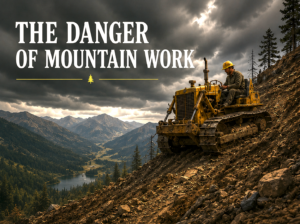 Working on steep forest terrain with tractors, bulldozers, chainsaws, trucks, and other heavy equipment has always been dangerous. Equipment has improved since Falk’s time, but mountain work remains unforgiving. Steep grades, unstable ground, falling trees, sudden weather, and limited emergency access still leave little room for error.
That danger remains directly relevant to those of us who love this valley. Property owners, contractors, firefighters, utility crews, and volunteers regularly work on steep slopes, clear dangerous trees, maintain access routes, and protect homes and public lands. Today, visitors experience places such as Blue Lakes as settings of beauty and refuge, often without seeing the difficult and sometimes dangerous work required to create and maintain access to them.
We honor that service by respecting the risks of mountain work, supporting those who perform it, and refusing to treat their safety as less important than our access or convenience.
.
What We Inherit Becomes Our Responsibility
.
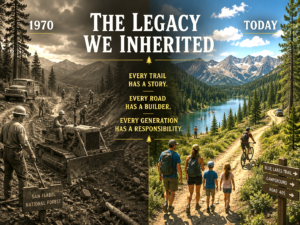
Most public-service work becomes invisible once it is completed. People see the trail, not the person who cut it. They see the road, not the operator who worked on the slope. They enjoy the forest but rarely know who measured its snowpack, fought its fires, repaired its access, or maintained its facilities.
Much of what we value in this valley was built, protected, and sustained by people whose names have largely been forgotten. They installed water lines, maintained roads, cleared debris, served on boards, fought fires, and organized evacuations. Remembering people like Elden Falk gives us an opportunity to see these familiar benefits with fresh appreciation and to honor the service that made them possible.
.
 .
.
Elden Falk’s story should lead us to more than admiration for a man from another generation. His example asks what stewardship requires of us now. Most of us will never operate heavy equipment on steep mountain terrain or perform the dangerous work that claimed his life, but we can continue the ethic of service he represented.
We do that by maintaining our property responsibly, supporting wildfire mitigation, protecting forest health, respecting public lands, valuing the workers who maintain roads and infrastructure, volunteering when our community needs help, and preserving the stories of people whose contributions might otherwise be forgotten.
Falk’s legacy is not a call to repeat the dangers he faced. It is a call to accept our own responsibility for the valley he helped serve. We honor his sacrifice best when we become faithful stewards of what his generation placed in our care.(13)