
 A wildfire does not have to reach your cabin as a wall of flames to destroy it. Many homes ignite when wind-driven embers land in dry pine needles, leaves, firewood, brush, or debris close to the structure. That is why forest mitigation is not just about making your property look cleaner. It is about giving your cabin, your neighbors, and firefighters a better chance when wildfire conditions become dangerous.
The best place to begin is closest to the cabin and then work outward. The goal is not to remove every tree or rake the forest down to bare dirt. A healthy forest needs some natural debris on the ground to protect the soil, hold moisture, and replenish nutrients. The real goal is to reduce dangerous fuels, remove dead material, limit ladder fuels, and create enough separation so fire has a harder time moving toward the home.
Every forested property is different. How much work you can do will depend on your time, budget, tools, physical ability, and the condition of your land. Not every owner can complete every step at once, so it helps to think in levels. Start with the work that gives your cabin the greatest protection, then move outward as time and resources allow.
.
Before Beginning Any Mitigation Work
.
 Fire restrictions can change quickly and may limit when and how chainsaws, weed trimmers, mowers, and other spark-producing equipment may be used. Before beginning work, check the current Huerfano County fire-restriction stage and follow all applicable county, fire-district, and public-land requirements.
During higher restriction stages, motorized equipment may be allowed only for legitimate fire-mitigation work and may require specific precautions, including approved spark arresters, fire extinguishers, shovels, and notification to Huerfano County Dispatch. Never assume that equipment use is permitted simply because the work is intended to reduce wildfire risk.
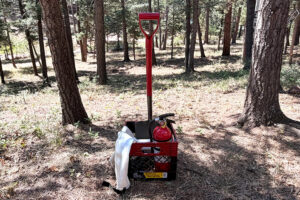
When using a chainsaw or other motorized equipment, follow all current fire restrictions and manufacturer safety requirements. Use equipment with an approved spark arrester when required, and keep a 10-pound ABC fire extinguisher and a shovel within immediate reach. Set hot or spark-producing equipment only on bare mineral soil, gravel, a fire-resistant blanket, or another nonflammable surface, never on dry grass, pine needles, or forest debris.
Before beginning work, review Huerfano County’s current public-safety notices and Fire Ordinance for restrictions governing fire-mitigation activities, chainsaws, and other spark-producing equipment at the link below.
https://library.municode.com/co/huerfano_county/codes/code_of_ordinances?nodeId=COOR_CH10FI
.
Level 1: Protect the First Fifteen Feet Around the Cabin
.
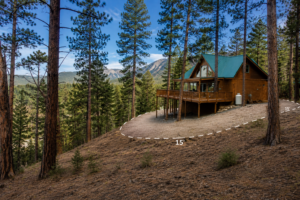 Begin with the area closest to the structure. This is the most important zone because windblown embers often ignite homes by landing in dry needles, leaves, mulch, firewood, brush, or debris near the house.
Remove combustible material from around the foundation, under decks, near stairs, beside propane tanks, and in roof valleys or gutters. Keep firewood, lumber, and other flammable materials away from the cabin. When possible, use gravel, rock, pavers, or other noncombustible materials immediately around the structure.
If you can only do one thing, clean the first fifteen feet around the cabin.
Level 2: Create Defensible Space Within 15–30 Feet
.
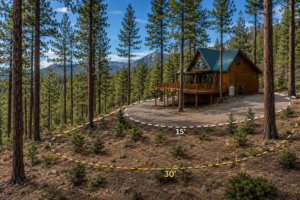 After the immediate area is addressed, focus on the next zone around the home. This area should be kept clean, open, and maintained so fire has a harder time moving toward the cabin.
Remove dead vegetation, dry brush, slash piles, fallen limbs, and larger sticks from the forest floor. Keep grasses and weeds cut low. Thin dense brush and separate shrubs, small trees, and other vegetation so fire does not have a continuous path to the home.
This does not mean every tree or plant must be removed. It means fuels should be reduced and separated.
Level 3: Remove Dead and Dangerous Trees
.
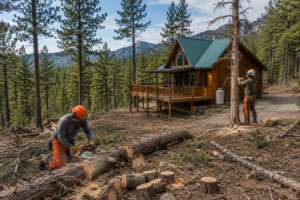 The next level is to remove dead trees, dying trees, and trees that could fall on the cabin, driveway, propane tank, power lines, or other important structures. Standing dead trees can become major wildfire fuel and can also create a serious safety hazard during wind, snow, or fire conditions.
This work may require professional help, especially when trees are large, leaning, close to structures, or difficult to access.
Level 4: Remove Ladder Fuels
.
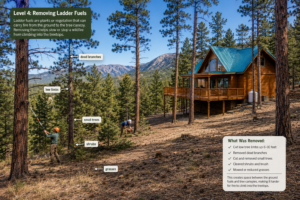 Once the dead material has been addressed, focus on ladder fuels. These are grasses, shrubs, small trees, low limbs, and dead branches that allow fire to climb from the ground into the tree canopy.
Prune lower limbs where appropriate, remove dead branches still attached to trees, clear small trees or brush growing under larger trees, and create separation between shrubs and overhanging branches. This process is often called limbing, pruning, or skirting trees.
The purpose is to help keep fire on the ground instead of allowing it to climb into the crowns of the trees.
Level 5: Maintain the Forest Floor
.
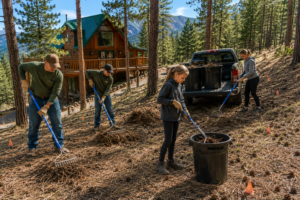 In Pinehaven’s pine-dominated forest, annual litterfall often happens faster than natural decomposition. Needles, cones, bark, twigs, and small branches keep falling to the forest floor faster than nature can fully break them down, especially in shaded, dry areas beneath the trees. Over time, that creates ongoing fuel accumulation, which is why forest mitigation should be treated as routine cabin maintenance rather than a once-in-a-generation cleanup.
The final level is ongoing maintenance. Lightly rake or remove excess pine needles, leaves, small sticks, and other fine fuels, especially near the cabin, along driveways, around decks, and in areas where debris naturally collects.
Do not scrape the forest floor down to bare dirt everywhere. The forest floor helps hold moisture, protect soil from erosion, feed trees, and support the natural ecosystem. The goal is to reduce excessive fuel buildup, not sterilize the land.
A good stopping point is when the heavy buildup of dry needles, leaves, sticks, branches, and deadfall has been removed, while a thin natural layer remains. In simple terms: if fire could easily crawl through it, remove more; if the ground is protected but no longer loaded with dry fuel, stop.
A Healthier, Safer Forest
Caring for a forested property does not require doing everything at once. The most important step is to begin in the right place. Start near the cabin, reduce the fuels that create the greatest risk, and then keep working outward as time, strength, and resources allow.
The goal is not to strip the land bare or turn the forest into a city lot. The goal is to create a healthier, safer property where fire has less fuel, fewer pathways, and a harder time reaching the home. Every branch removed, every ladder fuel reduced, and every clean space around a cabin helps protect not only one property, but the larger and healthier Pinehaven community.
.
Bonus Video Content
This three-minute video explains ladder fuels and offers practical tips for mitigating the area around your cabin to reduce wildfire intensity, slow its spread, and lower the risk of structure loss.