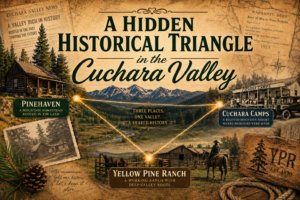
 History sometimes hides in plain sight. In local history, pieces often sit quietly beside one another for years before their connection becomes visible. Pinehaven, Cuchara Camps, and Yellow Pine Ranch are often remembered as separate places, each with its own story. Pinehaven grew from homestead land into a mountain community. Cuchara Camps helped shape the valley’s early resort identity. Yellow Pine Ranch carried forward the area’s ranching tradition. Yet these three places share an important historical link through the Powell family.
A Triangle of History
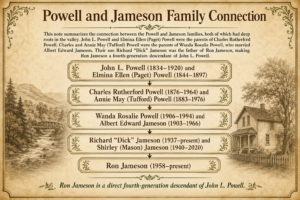 One of the most significant links between Pinehaven, Cuchara Camps, and Yellow Pine Ranch runs through the Powell family. John L. Powell came from the east, crossed the plains, in a covered wagon and originally homesteaded the land that later became Pinehaven.(1) His son, Charles Rutherford Powell, later purchased and operated Cuchara Camps, according to local news reports from 1931.(2) Wanda Rosalie Powell, daughter of Charles R. Powell, married Albert Edward Jameson, connecting two families with deep roots in the valley.(3)
The connection extended again in 1948, when Albert Edward Jameson purchased Yellow Pine Ranch from Charles Rutherford Powell.(4) After Albert’s death in 1963, his wife, Wanda Jameson, continued operating the ranch until her son, Richard “Dick” Jameson, purchased it from her.(5) The Jameson family owned and operated Yellow Pine Ranch until it was sold to David Evans in 1975. Together, these connections reveal a historical triangle linking Pinehaven’s homestead origins, Cuchara Camps’ resort history, and Yellow Pine Ranch’s ranching legacy.(6)
To help visualize this family connection, a short video accompanying this article includes photographs representing each generation of the Powell and Jameson story.(7)
The significance of this connection is not that one family owned several pieces of land. The deeper point is that one family line helps connect three different eras of valley history: homesteading, resort development, and ranching. Through the Powells and Jamesons, Pinehaven’s story reaches beyond its roads and cabins into the broader history of the Cuchara Valley.
Why it Matters
This connection matters because it reminds us that local history is not built from isolated landmarks. It is built from people, land, family decisions, and the quiet transfer of memory from one generation to the next.
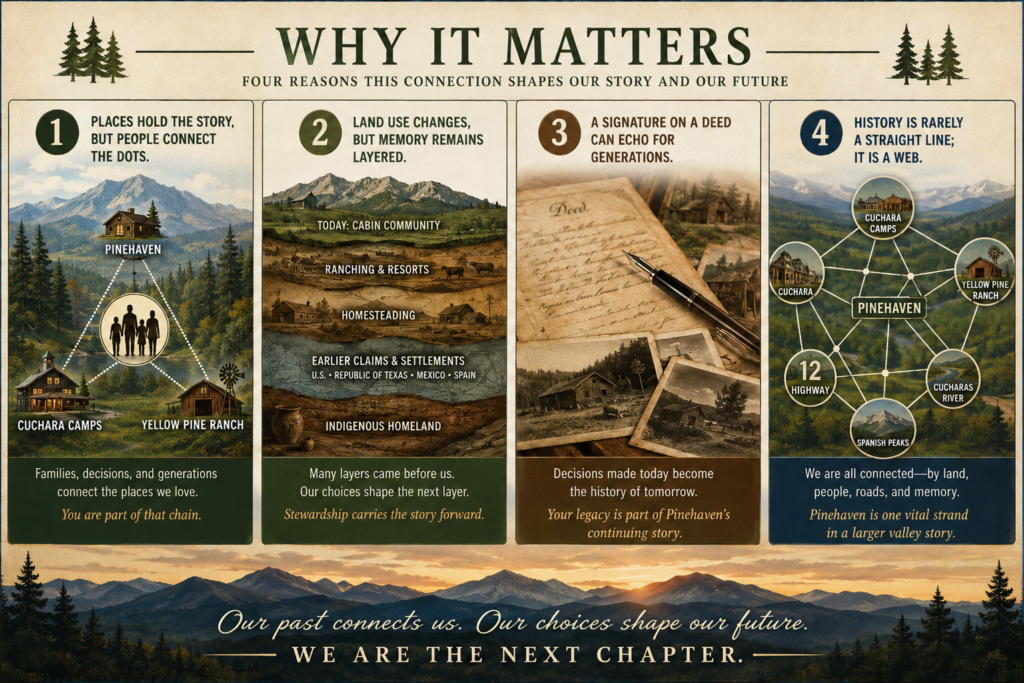
1. Places hold the story, but people connect the dots.
Pinehaven, Cuchara Camps, and Yellow Pine Ranch can look like three separate histories: one subdivision, one resort area, and one ranch. But the Powell family shows that the real thread connecting them is personal. Land, businesses, and communities often pass through family decisions, relationships, and generational movement.
For Pinehaven cabin owners today, this means their cabins are not just located in a scenic mountain subdivision. They are part of a human story shaped by families, landowners, builders, neighbors, and caretakers who came before them. The Powell family, the Jameson family, John C. Vories, Steve Pierotti and his son Robert, and later Pinehaven residents all helped shape what owners now enjoy. Every cabin owner becomes part of that continuing chain.
2. Land use changes, but memory remains layered.
What we see today is only the top layer of the story. Before Pinehaven became a cabin community, this valley was Indigenous homeland. It later passed through overlapping claims of the Spanish Crown, the Mexican Republic, the Republic of Texas, and the United States.(8)
In more recent generations, the land became tied to homesteading, ranching, resort development, and mountain community life. Pinehaven is not just a subdivision among the pines. It stands on layered stories of people, land, work, family, travel, and memory.
Today’s Pinehaven owners may experience the area as a place of rest, family, wildlife, and mountain beauty. But beneath that present use are older layers: Indigenous homeland, homestead land, ranching activity, resort development, timber, roads, water systems, fire mitigation, and community governance. Owning a cabin in Pinehaven means living on land that has carried many layers of meaning before it became a place of weekend retreats and family memories.
Tree removal, fire mitigation, drainage improvements, road maintenance, building repairs, exterior changes, and water decisions may not feel historical. But they are. Future owners will live with the results. Just as past land transfers shaped today’s Pinehaven, today’s maintenance and stewardship choices will shape tomorrow’s Pinehaven.
3. A signature on a deed can echo for generations.
A homestead patent, a ranch sale, or a resort purchase may seem ordinary at the time. But decades later, those transactions explain why communities formed where they did, why families became associated with certain places, and how one generation shaped the landscape inherited by the next.
The deeds, purchases, and transfers that connected Powell land, Cuchara Camps, and Yellow Pine Ranch may have seemed ordinary at the time. Yet those decisions helped shape the valley’s future. That should remind today’s cabin owners that their own choices also matter.
Every family gathering, remodel, cabin name, trail walked, photo taken, porch conversation, and holiday tradition becomes part of Pinehaven’s continuing story. What feels ordinary now may one day help explain how Pinehaven changed from a developer’s subdivision into a multigenerational mountain community.
How we maintain our property, manage trees, support the HOA, preserve documents and photographs, respect covenants, and care for the land will influence what Pinehaven becomes for the next generation.
4. History is rarely a straight line; it is a web.
The Powell-Jameson connection shows that Cuchara Valley history should not be told as isolated chapters. Pinehaven, Cuchara Camps, Yellow Pine Ranch, Cuchara, and the broader valley are interwoven. The more you trace names, deeds, newspapers, roads, and family relationships, the more the region’s story becomes connected.
Pinehaven cabin owners are not isolated from Cuchara, Yellow Pine Ranch, Highway 12, the Spanish Peaks, the Cuchara River, or the broader valley. Their cabins belong to an interconnected regional story. Understanding that web can deepen appreciation for local roads, neighboring properties, historic families, fire history, water systems, and community relationships. Pinehaven is not just a destination; it is one strand in the larger fabric of the Cuchara Valley.
History is not a straight road; it is a network of connected paths.
Three Roads, One Story
A bright pop-country duet that connects Pinehaven, Yellow Pine, and Cuchara Camps through one hidden family thread. Catchy, hopeful, and rooted in the Cuchara Valley, it turns local history into a song of land, legacy, and mountain memory.
The History We Are Creating Now
Today’s cabin owners may be creating history in quieter ways than they realize. The mistake is assuming history only happens when something dramatic occurs. Most local history is built from ordinary decisions that later become important because they reveal how people lived, what they valued, and how they cared for a place.
History is not just what happened at a place; it is how people, land, and memory become connected over time.(9)
Footnotes
Parenthetical numbers in the text (e.g., 5) correspond to the sequentially numbered citations listed below.
1. Gene Roncone and Rhonda Roncone, “From Battlefield to Backwoods: Homesteader John L. Powell,” Cabin in the Pines, Journal 4, accessed June 21, 2026, https://cabininthepines.org/journal-4-from-battlefield-to-backwoods-homesteader-john-l-powell/.
2. Huerfano County News, “La Veta News,” March 1931 (“Charlie Powell plans to buy Cuchara Camps, pending settlement of the Mayes estate”) and June 1931 (“Charles Powell now is the owner of Cuchara Camps”), compiled in Karen Mitchell, Huerfano County News Articles 1930–1934, accessed June 7, 2025, https://www.kmitch.com/Huerfano/news1930.html.
3. “Charles Rutherford Powell (1876–1964),” profile listing Wanda Rosalie Powell as a daughter, FamilySearch, accessed June 21, 2026, https://ancestors.familysearch.org/en/GZP9-9VS/charles-rutherford-powell-1876-1964.
4. “Jameson, Raymond C.,” Pueblo Chieftain, November 10, 2005, transcribed in Karen Mitchell, “Tri-County Obituaries 1J,” accessed June 7, 2025, https://www.kmitch.com/Pueblo/obits/1j.html.
5. Ron Jameson, text-message thread with Gene Roncone, June 13–14, 2026.
6. This note summarizes the connection between the Powell and Jameson families, both of which had deep roots in the valley. Powell and Jameson family connection: John L. Powell and Elmina Ellen (Paget) Powell were the parents of Charles Rutherford Powell. Charles and Annie May (Tufford) Powell were the parents of Wanda Rosalie Powell, who married Albert Edward Jameson. Their son Richard “Dick” Jameson was the father of Ron Jameson, making Ron Jameson a fourth-generation descendant of John L. Powell.
John L. Powell (1834—1920) and Elmina Ellen (Paget) Powell (1844—1897)
↓
Charles Rutherford Powell (1876—1964) and Annie May (Tufford) Powell (1883—1976)
↓
Wanda Rosalie Powell (1906—1994) and Albert Edward Jameson (1903—1966)
↓
Richard (Dick) Jameson (1937—present) and Shirley (Mason) Jameson (1940—2020)
↓
Ron Jameson (1958—present)
Ron Jameson is a direct fourth-generation descendant of John L. Powell
7. Photographs used in the accompanying video are from Greg Jameson, comp., The True Story of a Bashful Girl: The Legacy and Memoirs of Annie Powell and Wanda Jameson (2012), Kindle edition.
8. Gene Roncone and Rhonda Roncone, “Flags Over the Forest,” Cabin in the Pines, Journal 2, accessed June 21, 2026, https://cabininthepines.org/journal-2-flags-over-the-forest/.
9. Author’s note: In preparing this article, the author used AI-assisted tools for research support, proofreading, fact-checking, and stylistic refinement. All narrative choices, analysis, and historical interpretations are the author’s own, and responsibility for accuracy rests solely with the author. The blog’s research methodology statement is available at https://cabininthepinescuchara.blogspot.com/2019/03/methodology-sources-and-use-of-research.html