

A good plan tells you where to start. Experience teaches you how to keep going.
After years of maintaining cabins in Pinehaven, longtime owners have learned that caring for forested property is easier when you work with a few practical habits, the right tools, and a realistic pace. This journal gathers some of those community-tested tips to help you work smarter, reduce wildfire risk, and care for your forested property without becoming overwhelmed.
.
1. Before Beginning Any Mitigation Work
.
 Fire restrictions can change quickly and may limit when and how chainsaws, weed trimmers, mowers, and other spark-producing equipment may be used. Before beginning work, check the current Huerfano County fire-restriction stage and follow all applicable county, fire-district, and public-land requirements.
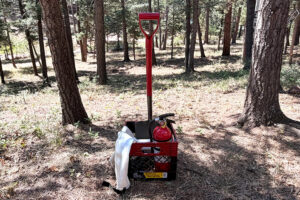
During higher restriction stages, motorized equipment may be allowed only for legitimate fire-mitigation work and may require specific precautions, including approved spark arresters, fire extinguishers, shovels, and notification to Huerfano County Dispatch. Never assume that equipment use is permitted simply because the work is intended to reduce wildfire risk.
When using a chainsaw or other motorized equipment, follow all current fire restrictions and manufacturer safety requirements. Use equipment with an approved spark arrester when required, and keep a 10-pound ABC fire extinguisher and a shovel within immediate reach. Set hot or spark-producing equipment only on bare mineral soil, gravel, a fire-resistant blanket, or another nonflammable surface, never on dry grass, pine needles, or forest debris.
Before beginning work, review Huerfano County’s current public-safety notices and Fire Ordinance for restrictions governing fire-mitigation activities, chainsaws, and other spark-producing equipment at the link below.
https://library.municode.com/co/huerfano_county/codes/code_of_ordinances?nodeId=COOR_CH10FI
2. Participate in Pinehaven’s Bi-Annual Forest Debris Pick-Up
.
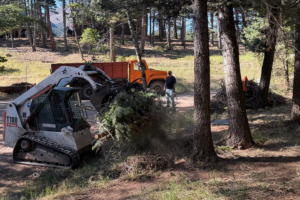 Pinehaven’s free bi-annual forest debris pick-up helps cabin owners reduce wildfire risk by removing pine needles, twigs, small branches, pinecones, leaves, and other fine fuels from around their properties. This service is part of the community’s ongoing Firewise mitigation effort.
Two pick-ups are typically scheduled each year: one around July 1 and another near the end of September. Journal 27 answers common questions about this HOA service, including what materials are accepted and how cabin owners should prepare debris for pick-up.
3. Know What to Do Yourself and What to Hire Out
.
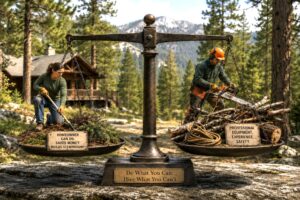 Many mitigation tasks can be handled by cabin owners, including raking pine needles, collecting small branches, pruning low brush, and moving light debris. Other work may require professional help, especially hauling large debris piles, removing high limbs near structures, or taking down tall, dead, leaning, or difficult trees.
For owners who need assistance, John Albright from La Veta is available for hire. The HOA and many cabin owners use John because he arrives promptly, comes fully equipped, works safely, and understands forested mountain properties. He can be contacted by phone or text at (719) 859-1727.
4. Keep the Right Tools at the Cabin
.
Sooner or later, every mountain cabin owner needs a few basic tools. Keeping them at the cabin makes it easier to do small amounts of mitigation whenever you are there, instead of waiting until the work becomes overwhelming.
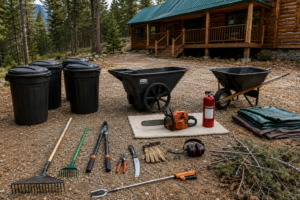 Helpful tools include:
- Heavy-duty metal bow rake
- Small hand rake
- Loppers for cutting branches and limbs
- Hand pruners for small twigs and stems
- Hand pruning saw
- Pole pruner
- Work gloves
- Eye and hearing protection
- Wheelbarrow, ranch cart, tarp, or four 32-gallon rubber trash cans for moving debris
- Extension grabber for picking up sticks and small debris
- Small chainsaw for cutting deadfall, but only for those trained and comfortable with chainsaw safety
If you use gas-powered tools or equipment with spinning blades that could create sparks, set the equipment down only on a fire blanket, bare mineral soil, gravel, or another nonflammable surface. It is also wise to keep a 10-pound ABC fire extinguisher within quick reach as a precaution.
5. Divide the Property Into Work Zones
.
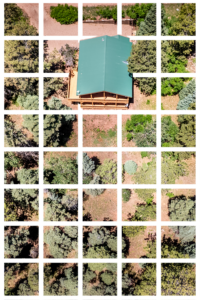 A forested property can feel overwhelming if you try to tackle everything at once. Divide the land into manageable work zones and focus on one section at a time. Bright survey flags, small soccer cones, or other markers can help you remember where you are working and where you stopped.
It also gives you a visible sense of progress. When one zone is finished, step back, clean up the tools, and mark that area complete before moving to the next section. Forest mitigation is not usually finished in one long push. It is completed through steady, repeatable progress over time.
This is especially helpful when family members or volunteers are working together. It keeps everyone focused, prevents duplicated effort, and helps you work methodically from the cabin outward.
This approach will also help you know where you left off after seasonal breaks. A large job becomes much more manageable when it is broken into smaller sections and each zone is given equal attention.
.
6. Work Smart and Save Your Back
.
Forest mitigation is hard physical work, especially on mountain properties with slopes, uneven ground, and heavy debris. A few simple habits can make the work safer and less exhausting.
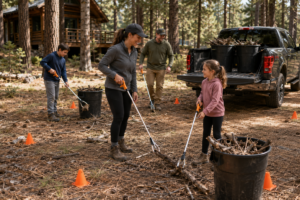 Work in short shifts instead of trying to finish everything in one long push. Use tarps, sleds, carts, ropes, trailers, or trash cans to move debris instead of carrying everything by hand. Four or five 32-gallon rubber trash cans can be especially useful because they are lightweight, easy to drag across the forest floor, and simple to empty into a debris pile. If you have a small 4×4 truck, you can load the filled cans into the bed, drive them to the pile, and empty them there.
Quality tarps are another convenient way to gather and drag pine needles, sticks, and small branches while pruning or raking. If your property is on a grade, work horizontally across the slope instead of constantly moving straight up and down the hill. An extension grabber can also save a surprising amount of bending when picking up small sticks. The wider “alligator grip” style usually works better than narrow grabbers with small rubber tips.
A Sustainable Rhythm
.
Maintaining a forested property is easier when the work becomes a rhythm instead of a rescue project. A little effort each season can prevent years of debris from piling up and turning into a much larger problem.
Use the community resources available, keep a few reliable tools at the cabin, know when to ask for help, and work in manageable sections. Over time, these simple habits make the property safer, the work less overwhelming, and the forest healthier for everyone who calls Pinehaven home.
.
Bonus Video Content
.
This three-minute video explains ladder fuels and offers practical tips for mitigating the area around your cabin to reduce wildfire intensity, slow its spread, and lower the risk of structure loss.