 Long before hikers traced the ridgelines above Cuchara, survey crews were marking boundaries in timber and stone, defining what would become the San Isabel Forest Reserve. Those boundaries were drawn under a presidency that reshaped American conservation policy: Theodore Roosevelt’s.
Today the San Isabel National Forest contains 19 of the state’s 53 fourteeners (peaks over 14,000 feet), is one of eleven National Forests in Colorado, has seven officially designated wilderness areas, and has 1,120,233 acres spread over eleven counties.(2)
A Voice for the Forest
Roosevelt possessed a passionate appreciation for the forest and often spoke publicly of our need to preserve them.
“We are consuming our forests three times faster than they are being reproduced. Some of the richest timber-lands of this continent have already been destroyed, and not replaced, and other vast areas are on the verge of destruction. Yet forests, unlike mines, can be so handled as to yield the best results of use, without exhaustion, just like grain-fields.”(3)
“We have become great because of the lavish use of our resources. But the time has come to inquire seriously what will happen when our forests are gone…”(4)
This is one area close to home for which each of us owes a debt of gratitude to Teddy Roosevelt. His conservation policies between 1901 and 1909 laid the groundwork for the recovery of Raspberry Mountain after decades of heavy logging.
There is substantial documented evidence supporting the local tradition that deforestation from mining, railroad building, and logging was the primary driver behind the creation of forest reserves in Colorado, including the San Isabel Forest.(5 & 6) Roosevelt’s Presidential Proclamation 467 established the San Isabel Forest Reserve in 1902 and stated the need to protect forest resources.(7)
Ravaged and Restored
By the early 20th century, unrestrained logging had ravaged Raspberry Mountain. As early as 1901, local citizens urged the government to protect the forest through intervention.(8) Alarmed by the rapid stripping of the southern Sangre de Cristo range, federal officials established the Las Animas Forest Reserve in 1907 to safeguard the Cuchara Valley.(9) A few years later, President Roosevelt incorporated the land and protections into the San Isabel National Forest in 1910. (10) Local boosters hailed the decision, confident it “would end the wholesale slaughter of timber” on Raspberry Mountain and in the surrounding hills.(11)
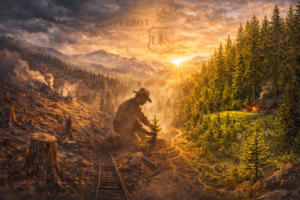 With the creation of the Forest Reserve came the first professional rangers and a new era of rules for harvesting timber. Logging didn’t disappear, but the days of unchecked cutting were over. The Forest Service introduced permits and sustainable yield practices, replacing the free-for-all of previous decades with measured, supervised activity. Small timber sales still met local needs, ranchers could secure firewood or fence-post permits, and sawmillers occasionally purchased logs, but the sprawling, uncontrolled logging camps of the past were gone.
The Forest Service began restoring the land, and by 1923 rangers were planting seedlings in a broad reforestation push (“re-timbering”) across the San Isabel National Forest section of the area.(12) In addition, fire prevention and watershed protection became guiding principles, allowing much of the mountain to heal naturally into a dense, second-growth forest.
You can read more about the restoration of our local forest at www.cabininthepines.org in Journal 40 entitled, “Ravaged and Restored; The Logging History of Raspberry Mountain”(13) Today, Raspberry Mountain stands cloaked in green once again and is a living testament to resilience, stewardship, and the vision of Teddy Roosevelt.
Living Out Legacy
Raspberry Mountain stands green again not by accident, but by decision. Lines were drawn. Policies were written. Rangers were hired. Seedlings were planted. And a president insisted that forests could be used without being used up.
If Roosevelt believed forests could be “handled… without exhaustion,” then the responsibility now rests with us. The San Isabel is no longer a distant federal experiment. It is our backyard. Our watershed. Our skyline.
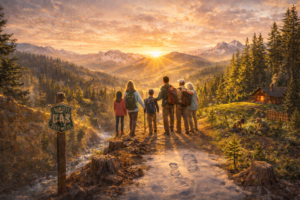 There are practical ways we can continue the stewardship he began:
- First, practice responsible recreation. Stay on marked trails. Pack out what you pack in. Respect seasonal closures and fire restrictions. Small disciplines protect fragile alpine soils and prevent erosion that can take decades to heal.
- Second, reduce wildfire risk around our homes. Create defensible space. Clear deadfall. Trim lower branches. Support community fire mitigation efforts. A century of conservation can be compromised in a single careless season.
- Third, support sustainable forestry and watershed protection. Learn how the Forest Service manages the San Isabel today. Attend local meetings and volunteer for service projects. Encourage balanced policies that protect both forest health and local livelihoods.
- Fourth, teach the next generation why this matters. Tell the story. Share the history of Raspberry Mountain. Bring children onto the trails and explain why the trees around them were once nearly gone. Stewardship survives only when it is passed on.
- Fifth, live with gratitude rather than entitlement. The forest is not merely scenery. It is water security, wildlife habitat, soil protection, and climate regulator. When we see it as gift rather than commodity, our decisions change.
Roosevelt warned that America was consuming its forests faster than they could be replaced. More than a century later, his warning still echoes through the timbered folds of the Cuchara Valley.
The green cloak that now covers Raspberry Mountain is not just a recovery story from the past. It is a charge to the present. If Roosevelt’s generation drew the boundary lines, ours must guard them. And long after our own debates are forgotten, may these mountains still stand — not as monuments to policy, but as living proof that stewardship endures.(14)
Footnotes
Parenthetical numbers in the text (e.g., 5) correspond to the sequentially numbered citations listed below.
1. National Forest Service Library, “San Isabel Forest Reserve & National Forest, Colorado, 1902-Present,” https://nfsl.contentdm.oclc.org/digital/api/collection/p17053coll4/id/1307/download.
2. San Isabel National Forest, Wikipedia, last modified February 18, 2026, https://en.wikipedia.org/wiki/San_Isabel_National_Forest — a summary article describing the history, geography, and administration of the San Isabel National Forest, including its establishment, land area, and place within the U.S. Forest Service.
3. Theodore Roosevelt, Address to the Deep Waterway Convention, Memphis, Tennessee, October 4, 1907. In American Waterways (1908). https://www.theodoreroosevelt.org/content.aspx?club_id=991271&module_id=339514&page_id=22&utm_source=chatgpt.com
4. Sarah McNaughton-Peterson, “Teddy Roosevelt’s Conservation Contributions,” Farm Progress, February 20, 2024, https://www.farmprogress.com/commentary/teddy-roosevelt-s-conservation-contributions-.
5. Organic Act of 1897, Wikipedia, last modified February 9, 2026, https://en.wikipedia.org/wiki/Organic_Act_of_1897; this act authorized the U.S. Forest Service and established that “the purpose of [forest reserves] is to improve and protect the forest within the boundaries… and to secure favorable conditions of water flows, and to furnish a continuous supply of timber….”
6. Organic Act of 1897, ch. 2, 30 Stat. 11 (June 4, 1897), U.S. Congress; reprinted as “Organic Act of 1897” (PDF), Public Lands for the People, accessed February 20, 2026, https://www.publiclandsforthepeople.org/wp-content/uploads/2015/05/ORGANIC-ACT-OF-1897.pdf — the foundational statute that provided the U.S. Forest Service with its organic authority to manage forest reserves, directing that forest lands be administered “to improve and protect the forest within the boundaries… and to secure favorable conditions of water flows, and to furnish a continuous supply of timber for the use and necessities of citizens of the United States.”
7. Proclamation 467 — Establishing the San Isabel Forest Reserve (April 11, 1902)
URL: https://www.presidency.ucsb.edu/documents/proclamation-467-establishing-the-san-isabel-forest-reserve
8. Nancy Christofferson, “Regional History – Mountain Living,” The World Journal, published July 16, 2020, accessed August 16, 2025, https://worldjournalnewspaper.com/regional-history-mountain-living
9. Harold K. Steen, The National Forests of the United States: A Chronological Record, 1891–2012 (Durham, NC: Forest History Society, 2013), 37,https://foresthistory.org/wp-content/uploads/2017/01/National-Forests-of-the-U.S.pdf.
10. U.S. Forest Service, “Rocky Mountain Region,” February 25, 2020, National Museum of Forest Service History, accessed August 16, 2025,https://forestservicemuseum.org/wp-content/uploads/2020/02/Rocky-Mountain-Region-Feb25-2020.pdf.
11. Nancy Christofferson, “Regional History – Mountain Living,” The World Journal, July 16, 2020, accessed August 15, 2025, https://worldjournalnewspaper.com/regional-history-mountain-living/.
12. Monument Nursery,” History Colorado, last modified June 12, 1996, para. 3, accessed August 15, 2025, https://www.historycolorado.org/location/monument-nursery.
13. Gene Roncone, “Journal 40: Ravaged and Restored; The Logging History of Raspberry Mountain,” Cabin in the Pines(blog), August 1, 2022, https://cabininthepines.org/journal-40-ravaged-and-restored-the-logging-history-of-raspberry-mountain/
14. Author’s note: In preparing this article, the author used AI-assisted tools for research support, proofreading, fact-checking, and stylistic refinement. All narrative choices, analysis, and historical interpretations are the author’s own, and responsibility for accuracy rests solely with the author. The blog’s research methodology statement is available at https://cabininthepinescuchara.blogspot.com/2019/03/methodology-sources-and-use-of-research.html