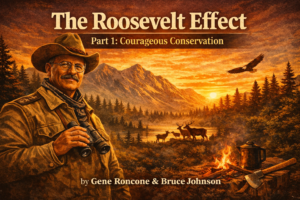
He was a political anomaly in an age of caution and calculation, a president more inclined to saddle up than to sit still. Few American presidents matched the intensity of Theodore Roosevelt’s devotion to conservation.(1)
His commitment was not a matter of political fashion but of personal conviction, rooted in experience. As a frail child growing up in New York City, he strengthened both body and spirit by studying animals, collecting specimens, and seeking every opportunity to explore the outdoors. Those early fascinations with nature deepened during his years in the Dakota Territory in the 1880s. There, as a hunter and rancher, he witnessed the rapid disappearance of the great bison herds and the steady depletion of wildlife. The lesson was clear. America’s natural abundance was not limitless.
Influenced by conservation leaders such as Gifford Pinchot, he embraced the principle he called “wise use.”(2) Natural resources, he believed, should be managed scientifically and sustained carefully for the long-term benefit of the public rather than exhausted for short-term gain.(3)
His vision of conservation was not confined to a single speech or policy. It was embodied in the force of his leadership. He became the message and decisions made in Washington would eventually ripple into the high country of southern Colorado on several fronts. (4)
Land Reservation
From the moment he assumed the presidency in 1901, Theodore Roosevelt moved conservation out of debate halls and into law. During his two terms, he transformed it from a hopeful theory into national policy. He signed legislation grounded in the conviction that certain landscapes should be preserved “for the use and benefit of our people as a whole,” not surrendered to narrow private interests.(5) Under his leadership, five national parks were created or expanded, eighteen national monuments were established through the Antiquities Act of 1906, and 150 national forests were set aside. In all, approximately 230 million acres of public land came under federal protection during his presidency.(6)
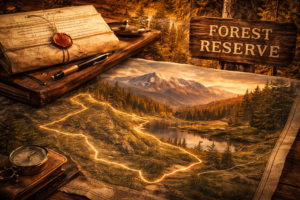 Without those protections, the story of many Western valleys and mountain landscapes might have unfolded very differently. Heavy timber extraction or unchecked development could have reshaped skylines, drained watersheds, and closed off access to lands now enjoyed by millions. Instead, protected forests became the backdrop for hiking, fishing, hunting, skiing, and the steady rise of mountain cabin communities.
Local economies, including tourism and second-home ownership, grew in the shelter of public lands that remained intact. That stability flowed from Roosevelt’s philosophy of wise use. By reserving millions of acres for regulated and sustained use rather than speculative extraction, he helped ensure that valleys like Cuchara would mature beside living forests, not in the wake of their disappearance.
U.S. Forest Service
At the same time, Roosevelt advanced a bold new framework for managing the nation’s forests and natural resources. In 1905 he formally established the U.S. Forest Service and appointed its first chief, giving conservation a permanent home within the federal government rather than leaving it to scattered agencies and temporary commissions.(7) Forest policy, he insisted, should be grounded in science and guided by long-term thinking. Forests were to be conserved “for continued use,” managed carefully so they could yield timber, protect watersheds, and safeguard soils for generations yet to come.(8)
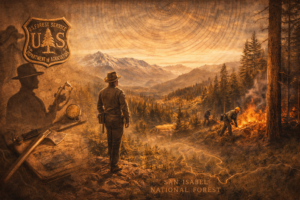 This philosophy of “wise use” rejected the short-term practice of environmental liquidation. The land was not something to cash out and walk away from. Forests, minerals, and soils were not windfalls to be stripped quickly, but resources that required planning, discipline, and restraint.(9) The results of that vision can still be seen across the American West, including in Cuchara’s San Isabel National Forest, established on April 11, 1902.(10)
When Forest Service crews thin timber or monitor fuel loads above the valley today, they are working within the institutional structure he set in motion. His conservation legacy was not simply preservation. It was organized, enduring stewardship woven into the daily management of the land.
Wildlife Conservation
Roosevelt’s conservation efforts extended beyond forests and into the protection of wildlife itself. In 1903 he established Pelican Island in Florida as the first federal bird reservation, safeguarding a threatened rookery and launching what would become the National Wildlife Refuge System.(11) It was a decisive step at a time when market hunting and the plume trade were driving bird populations toward collapse. In the years that followed, he created dozens of additional bird reservations and game preserves, seeking to curb commercial slaughter and rebuild declining populations of birds, bison, and other game animals.(12)
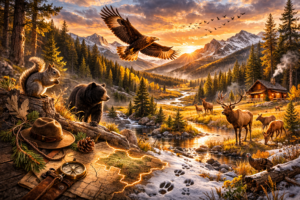 The benefits of that national shift are not confined to distant marshes or Western plains. They are visible in places like Cuchara. Elk and deer move quietly through timbered draws. Black bears, foxes, bobcats, and mountain lions inhabit the surrounding slopes. Wild turkeys scratch along the forest floor, while bighorn sheep and squirrels navigate rock and tree alike. Overhead, golden eagles circle on rising currents, falcons cut through open sky, and blue jays and hummingbirds animate the trees with flashes of color. The wildlife that passes by our cabins and migrates between high ridges and lower valleys is more than scenic background. It stands as living evidence of a deliberate change in national wildlife policy that reshaped the San Isabel Forest during his presidency. Every track in fresh snow, every shadow crossing the treetops, carries the imprint of a conservation choice made long ago.
Watershed Stewardship
Finally, Theodore Roosevelt understood that conservation was inseparable from water and from long-term national planning. Forests were not isolated stands of timber. They were the headwaters of rivers, the anchors of soils, and the regulators of entire regions. He supported measures such as the Newlands Reclamation Act of 1902, which financed irrigation projects across the arid West, and he convened national conferences to examine the interdependence of rivers, forests, soils, and navigation.(13) In a 1907 statement, he called the conservation of natural resources “the fundamental problem,” warning that if the nation failed to address it, other reforms would matter little.(14)
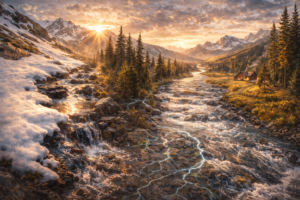 That principle flows directly into valleys like ours. Water descends from the surrounding mountains through Bend, Bonnett, Dodgeton, Baker, South Fork, and Cucharas Creek before moving past our cabins and into the Cuchara River. This watershed remains healthy because the high-country forests above it were not stripped in the early twentieth century. His policies treated mountain watersheds as essential infrastructure, long before that word became common in public debate. When the surrounding high country was reserved as part of what is now the San Isabel National Forest, the action accomplished far more than the preservation of scenery. It secured the water supply.
By curbing unregulated logging and overgrazing, federal policy preserved tree cover, reduced erosion, and protected the snowpack that feeds the valley each spring. The outcome has been steadier runoff, fewer destructive floods, healthier soils, and dependable creeks that sustain homes, ranches, and wildlife. In practical terms, conservation translated into stability and security for communities like Cuchara.
Roosevelt’s Invisible Footsteps
Theodore Roosevelt was, in many respects, ahead of his time. His reverence for the natural world and his authentic passion for conservation set a standard few of his presidential peers have matched.(15) His connection to Colorado rests not on folklore but on documented history. In January 1901, he spent five weeks on a cougar hunt near Meeker on the Western Slope.(16) In 1905, he returned to the state for a highly publicized bear hunt in Glenwood Springs, lodging at the Hotel Colorado and conducting presidential business from what locals proudly dubbed the “Western White House.”(17) He campaigned across Colorado as well, stopping in Longmont in 1900 and later in Denver in 1910, where his vigorous speeches drew enthusiastic crowds.(18)
 Yet for all his recorded travels through the Rockies, there is no evidence that he ever stood in the Cuchara Valley. He may never have looked upon its ridgelines or traced the course of its creeks. Still, his presence is felt here in ways more enduring than a brief visit ever could. His policies helped ensure that the forests surrounding the valley remained standing, that the peaks were not reduced to stumps and slag, and that the landscape retained the character residents and visitors continue to cherish. Among his most enduring gifts to this region stands the San Isabel National Forest, not as a monument of stone, but as a living landscape that continues to serve, shelter, and sustain the valley more than a century later.(19)
Footnotes
Parenthetical numbers in the text (e.g., 5) correspond to the sequentially numbered citations listed below.
1. National Park Service, “Theodore Roosevelt and Conservation,” U.S. National Park Service, last updated November 16, 2017, accessed February 19, 2026, https://www.nps.gov/thro/learn/historyculture/theodore-roosevelt-and-conservation.htm
2. Roosevelt’s conservation philosophy rested on the principle of “wise use,” meaning the careful, scientifically managed use of natural resources for “the greatest good of the greatest number for the longest time,” a formulation articulated by Forest Service Chief Gifford Pinchot and embraced by Roosevelt as federal policy. Gifford Pinchot, The Fight for Conservation (New York: Doubleday, Page & Company, 1910), 48–49, https://archive.org/details/fightforconserva00pinc.
3. National Park Service, “Theodore Roosevelt and Conservation,” U.S. National Park Service, last updated November 16, 2017, https://www.nps.gov/thro/learn/historyculture/theodore-roosevelt-and-conservation.htm.
4. National Park Service, “Theodore Roosevelt and Conservation,” last updated November 16, 2017, https://www.nps.gov/thro/learn/historyculture/theodore-roosevelt-and-conservation.htm.
5. American Museum of Natural History, “Theodore Roosevelt Timeline: Conservation President,” https://www.amnh.org/exhibitions/permanent/theodore-roosevelt-memorial/hall/roosevelt-timeline/conservation-president.
6. National Park Service, “Theodore Roosevelt and Conservation,” U.S. National Park Service, last updated November 16, 2017, https://www.nps.gov/thro/learn/historyculture/theodore-roosevelt-and-conservation.htm.
7. William W. Bergoffen, 100 Years of Federal Forestry, Agriculture Information Bulletin No. 402 (Washington, DC: U.S. Department of Agriculture, Forest Service, 1976), sec. 2, “The Early Years of the Forest Service, 1905–1916,” https://npshistory.com/publications/usfs/aib-402/sec2.htm
8. National Park Service, “Theodore Roosevelt and Conservation.” https://www.nps.gov/thro/learn/historyculture/theodore-roosevelt-and-conservation.htm
9. Theodore Roosevelt Association, “The Conservationist,” https://www.theodoreroosevelt.org/content.aspx?page_id=22&club_id=991271&module_id=339340.
10. Richard C. Davis, ed., Encyclopedia of American Forest and Conservation History (New York: Macmillan, 1983), listing for “San Isabel Forest Reserve,” as documented in Forest History Society records, established April 11, 1902.
11. U.S. Fish and Wildlife Service, “Theodore Roosevelt (1858–1919) The Conservation President.” https://www.fws.gov/staff-profile/theodore-roosevelt-1858-1919-conservation-president
12. Theodore Roosevelt Conservation Partnership, “Theodore Roosevelt’s Legacy and Its Relevance to Conservation Today,” September 2, 2021, https://www.trcp.org/2021/09/03/theodore-roosevelts-legacy-relevance-conservation-today/.
13. Library of Congress, “Conservation in the Progressive Era.” https://www.loc.gov/classroom-materials/united-states-history-primary-source-timeline/progressive-era-to-new-era-1900-1929/conservation-in-progressive-era/
14. U.S. Fish and Wildlife Service, “Theodore Roosevelt (1858–1919) The Conservation President.” https://www.fws.gov/staff-profile/theodore-roosevelt-1858-1919-conservation-president
15. National Park Service, “Theodore Roosevelt and Conservation,” U.S. National Park Service, last updated November 16, 2017, accessed February 19, 2026, https://www.nps.gov/thro/learn/historyculture/theodore-roosevelt-and-conservation.htm
16. Douglas Brinkley, as quoted in “Adventures from the Archives: Theodore Roosevelt’s World’s Record
Cougar,” Boone and Crockett Club, December 14, 2016, https://www.boone-crockett.org/adventures-archives-theodore-roosevelts-worlds-record-cougar.
17. “The Legend of the Teddy Bear,” Hotel Colorado, accessed February 19, 2026, https://www.hotelcolorado.com/blog/hotel-colorado-legend-of-the-teddy-bear/.
18. Amy Zimmer, “Theodore Roosevelt in Colorado,” Colorado Virtual Library, August 15, 2021,
https://www.coloradovirtuallibrary.org/resource-sharing/state-pubs-blog/theodore-roosevelt-in-colorado/.
19. Author’s note: In preparing this article, the author used AI-assisted tools for research support, proofreading, fact-checking, and stylistic refinement. All narrative choices, analysis, and historical interpretations are the author’s own, and responsibility for accuracy rests solely with the author. The blog’s research methodology statement is available at https://cabininthepinescuchara.blogspot.com/2019/03/methodology-sources-and-use-of-research.html