 On a busy summer Saturday, it is easy to focus on what has changed — a few more cars on Main Street, a line at your favorite village restaurant, a trailhead that feels less hidden than it once did. But step back for a moment and ask a different question: What keeps a small mountain valley alive?
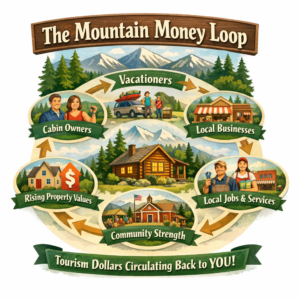 It begins with visitors. Families who come to hike, fish, and breathe the mountain air also spend a little money while they’re here. They rent cabins, eat in local restaurants, buy groceries, shop in stores, and pay for services. Out-of-area cabin owners inject money into the local economy by paying taxes, hiring local contractors, paying for utilities, supporting events, and making significant capital improvements. Those dollars do not disappear. They move and over time even multiply.
They move into local businesses, helping shop owners put food on the table, pay utilities, order inventory, and keep their doors open. They become wages for servers, maintenance crews, contractors, and retail clerks. They support mechanics, landscapers, cleaners, and tradespeople. In short, tourism dollars become local paychecks.
Those paychecks allow families to stay in the valley instead of moving elsewhere for work. They help residents cover taxes, insurance, and repairs so homes remain maintained rather than neglected. They support property values, providing long-term owners with security and equity. They strengthen the tax base that helps fund roads, services, and community events. What starts with a visitor’s meal or rental quietly circulates back into the everyday life of the valley.
 It would be naïve to ignore the concerns that come with growth. Longtime residents understandably worry about traffic, rising prices, overcrowding, and the gradual erosion of the quiet character that first drew them here. These concerns are legitimate and come from love. No one wants to see Cuchara lose its soul.
But there is a difference between uncontrolled expansion and healthy circulation. Tourism, when shaped by local values and thoughtful policies, is not about turning Cuchara into something it is not. It is about sustaining what it already is. Without economic vitality, small mountain communities decline and struggle to survive. Businesses close. Jobs disappear. When opportunity narrows, creative energy often migrates. Young families leave. Cabins sit dark, porches are quiet, and the fireplace hearth remains cold. And nobody wants that.
The Mountain Money Loop reminds us that tourism is not simply about visitors coming in. It represents opportunity circulating through the community, creating jobs, wages, maintenance, equity, and stability. In doing so, it provides long-term residents with a realistic way to continue living in the place they cherish.
The mountains were never meant to be locked away. They were meant to be experienced. When we thoughtfully share what we love, we are not surrendering it. We are investing in its future.
If we want Cuchara to remain a place where locals can live, work, and gather for generations to come, we must allow the mountain money to circulate. Why? Because sometimes the only way to preserve something beautiful is to be willing to share it.
Footnotes
Parenthetical numbers in the text (e.g., 5) correspond to the sequentially numbered citations listed below.
Author’s note: In preparing this article, the author used AI-assisted tools for research support, proofreading, fact-checking, and stylistic refinement. All narrative choices, analysis, and historical interpretations are the author’s own, and responsibility for accuracy rests solely with the author. The blog’s research methodology statement is available at https://cabininthepinescuchara.blogspot.com/2019/03/methodology-sources-and-use-of-research.html