
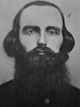
The wind tugged at John Powell’s coat as he surveyed the land just north of Cuchara. It wasn’t much. Just forest, rock, and possibility. But to a Civil War veteran with nothing but grit and a government promise of land, it looked like the future.
To understand how John L. Powell came to claim this place, it is necessary to begin far from Cuchara, in the world that shaped him.
Early Years in Pennsylvania (1834–early 1850s)
 John Lloyd Powell was born in Pennsylvania on April 23, 1834, to the parents of Walter Powell and Cordelia Knight. Though few records survive from this chapter of John’s life, the places he lived and the events unfolding around him offer important insight.
At this time Pennsylvania was experiencing steady but uneven change. Much of the state remained rural, shaped by small farms, local trades, and tight-knit communities, even as canals, turnpikes, and early railroads began to connect interior regions to eastern markets. Most families lived modestly, relying on agricultural labor and shared household work, with children contributing from a young age. National events such as the Panic of 1837 brought economic uncertainty to working families, while growing debates over slavery and westward expansion increasingly framed public life. For young men coming of age in this environment, opportunity often lay beyond familiar ground. The idea of moving west in search of land, work, or stability became increasingly common.(1) During these years, the notion of heading west may have begun to take root.
Clay County, Missouri, and the Eve of War (late 1850s–1860)
By the late 1850s, Powell had relocated to Clay County, Missouri, where he married Elmina Ellen Paget in December 1860. Clay County lay along the Missouri River in a border state deeply divided over slavery and allegiance to the Union. The region had recently endured political violence connected to sectional conflict, particularly during the period known as “Bleeding Kansas,” and tensions remained high as the nation moved toward war. Daily life for young couples in this setting revolved around agricultural work, family responsibilities, and a growing sense of instability that touched churches, communities, and households alike. Powell’s marriage took place just weeks before South Carolina’s secession in 1860, placing the beginning of his family life squarely within a moment of national fracture that would soon draw him into military service.(2)
The Powell Family and Cuchara’s Convergent History
Over time, the Powell family story would become increasingly intertwined with the development of Cuchara itself. One of John and Elmina’s sons would later purchase Cuchara Camps following the death of George Mayes, while other sons, grandsons, and even great-grandsons would emerge as community leaders in their own right. Those connections, and the fuller story of how the Powell family became woven into the life of the valley, will be explored in a forthcoming conversation with Ron Jameson, Cuchara’s current Fire Chief, whose family history and firsthand knowledge provide a living link to that past.
During the time of their marriage, John and Elmina became the parents of seven children, six sons and one daughter.(3) His children were John W. Powell (1865–1936), James L. Powell (1868–Date unknown), Laurance Powell (1869–Date unknown), Laura M. Powell (1870–1940), Walter Paget Powell (1871–1949), Charles Rutherford Powell (1876–1964), and Frank Berger Powell (1878–Date unknown).
Their names are significant because many of them and their descendants went on to make important contributions to Cuchara’s development and history.
John L. Powell: Union Civil War Veteran
John and his family moved to Kansas, where he was among the early volunteers to join the Union Army’s Company A, 8th Kansas Infantry.(4) The 8th Kansas Infantry served in the Western Theater and “Powell, John L. – Co. A” is listed on a Kansas Civil War roster.(5)
Regimental histories help fill in the contours of Powell’s wartime experience, even where individual records fall silent. Although no surviving roster traces his movements battle by battle, the service record of the 8th Kansas Infantry provides a reliable framework for understanding where he likely served. Company A was organized in Lawrence, Kansas, on August 28, 1861, placing Powell among the regiment’s earliest volunteers.
From there, the 8th Kansas was drawn into some of the Western Theater’s most demanding campaigns. These included the Battle of Perryville in October 1862, the Battle of Stones River, the Tullahoma Campaign, Chickamauga, the Siege of Chattanooga, the Atlanta Campaign, and the hard-fought battles of Franklin and Nashville, followed by duty in Texas near the war’s end.
Because Powell is listed in Company A and no evidence indicates an early discharge or transfer, it is likely that he followed the regiment through many of these campaigns, enduring long marches, tenuous supply lines, and hard fighting in the Western Theater.(6)
Westward by Covered Wagon and Homesteading
Decades after the war, Powell relocated to the Cuchara Valley by covered wagon in 1896.(7) It would have been quite an undertaking for a 62-year-old man. But the Powells were no strangers to hardship, and the journey demanded weeks of travel across plains, passes, and uncertain roads.
While specific details about his reasons for moving to La Veta are not documented, it was common for Civil War veterans to relocate westward after the war. La Veta, established in the 1870s, offered several agricultural, ranching, and mining opportunities, attracting many settlers seeking new beginnings. The town’s development and the availability of land likely influenced Powell’s decision to make it his home.
Homestead Act of 1862
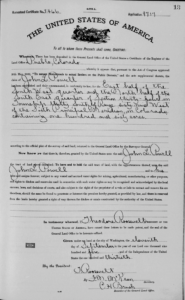 At the age of seventy, Powell embarked on a new beginning by taking advantage of a bold federal policy: the Homestead Act of 1862. This historic initiative was designed to spark westward expansion by offering 160 acres of land to anyone willing to build a life on the American frontier. To earn ownership, settlers had to:
– Live on the land for at least five years.
– Build a proper home with an enclosed roof, at least one door, and one or more windows.
– Cultivate part of the land.
– Show proof of their efforts after five years.(8)
In return, they received a land patent, a legal deed to call it their own.
However, time served by Union Civil War veterans was credited toward the five-year homestead residence requirement.(9) John took advantage of the veteran benefit and received a grant in 1905 for the land that is now Pinehaven, located approximately 1.5 miles north from the center of the Cuchara Village on Highway 12. At the bottom of Powell’s land grant appears the signature of another hardened frontiersman of history, President Theodore Roosevelt.(10)
Powell’s Death and Heirs
His early enlistment in the war, his later journey across the Continental Divide by covered wagon, and his decision to homestead in his seventies all point to a man of stamina, resolve, and strong conviction.
John died on April 11, 1920, in La Veta at the age of 85, and was buried in a La Veta Cemetery.(11) After his passing, his children inherited the land. Though they did a bit of logging, the land remained mostly untouched. In 1922, the siblings deeded their interest in the land solely to Charles R. Powell. Charles was also the grandfather of local resident Dick Jameson, who was associated with the family that owned the adjacent Yellow Pine Ranch.
Years later, in 1943, Charles R. Powell, son of John L. Powell, sold the land to John C. Vories for $1,500. Vories made a $200 down payment, with the rest to be paid gradually, along with a share of profits from any future timber harvests. By 1948, the land was officially his.
Pinehaven stands as the final chapter in John L. Powell’s long journey. Claimed late in life, the land reflects the endurance, patience, and resolve that had shaped him since his youth. In time, it would pass from his hands into the lives of his children and the broader Cuchara community, linking one man’s perseverance to a place that would outlast him.(12)
Footnotes
Parenthetical numbers in the text (e.g., 5) correspond to the sequentially numbered citations listed below.
1. James M. McPherson, Battle Cry of Freedom: The Civil War Era (New York: Oxford University Press, 1988), 3–55; Susan-Mary Grant, North Over South: Northern Nationalism and American Identity in the Antebellum Era(Lawrence: University Press of Kansas, 2000), 21–44.
2. Nicole Etcheson, Bleeding Kansas: Contested Liberty in the Civil War Era (Lawrence: University Press of Kansas, 2004), 1–25; William E. Parrish, A History of Missouri, Volume III: 1860 to 1875 (Columbia: University of Missouri Press, 1973), 1–18.
3. “John Lloyd Powell,” FamilySearch, accessed June 7, 2025, https://ancestors.familysearch.org/en/L7QN-DLR/john-lloyd-powell-1834-1920.
4. “Kansas Memory: Civil War Roster, John L. Powell,” Kansas Historical Society, accessed July 31, 2025, Kansas Memory, Kansas Historical https://www.kansashistory.gov/kmi/search/search/surname:Powell/fname:John/19:yes/submit:SEARCH. Also, Gravestone of John Lloyd Powell, Colorado Gravestones, accessed June 7, 2025,https://coloradogravestones.org/view.php?id=1307.
5. Kansas Adjutant General Roster, “Powell, John L., A,” Kansas Historical Regional Military Index, https://www.ksgenweb.org/archives/statewide/military/civilwar/adjutant/8/index.html?utm_source=chatgpt.com
6. “8th Kansas Infantry Regiment,” Wikipedia, accessed June 7, 2025,https://en.wikipedia.org/wiki/8th_Kansas_Infantry_Regiment.
7. Hazel E. Cross and Josephine C. Jochem, River of Friendship (Chicago: Adams Press, 1970), page 13.
8. Homestead Act of 1862, Public Law 37-64, U.S. Statutes at Large, Vol. 12, p. 392 [Available via U.S. National Archives or Library of Congress]
9. Under the Homestead Act of 1862, Union Army and Navy service during the Civil War was credited toward the five-year residence requirement, allowing veterans to deduct their time in service—and in some cases prove up a claim almost immediately after settlement; widows and minor children could also complete claims in the veteran’s stead. This privilege reduced the time requirement but did not increase acreage, and it applied only to Union veterans, not Confederate soldiers. National Archives, Homestead Act of 1862; U.S. Bureau of Land Management, General Land Office Records—Military Service Credit. https://www.archives.gov/milestone-documents/homestead-act?utm_source=chatgpt.com
10. U.S. Bureau of Land Management, “General Land Office Records,”https://glorecords.blm.gov/details/patent/default.aspx?accession=CO1430__.013&docClass=STA&sid=ph2ttvsp.eb3#patentDetailsTabIndex=1.
11. “John Lloyd Powell,” Family Search, accessed June 7, 2025, https://ancestors.familysearch.org/en/L7QN-DLR/john-lloyd-powell-1834-1920. In addition, and Gravestone of John Lloyd Powell, Colorado Gravestones, accessed June 7, 2025,https://coloradogravestones.org/view.php?id=1307.
12. Author’s note: In preparing this article, the author used AI-assisted tools for research support, proofreading, fact-checking, and stylistic refinement. The narrative, analysis, and historical interpretations are the author’s own, and responsibility for accuracy rests solely with the author. The blog’s research methodology statement is available at: https://cabininthepines.org/journal-81-methodology-sources-and-use-of-research-tools/