
 On a quiet morning in the Cuchara Valley, it is easy to assume that life here changes slowly. Cabins sit among the pines, the Spanish Peaks rise on the horizon, and the rhythm of the seasons feels timeless. Yet behind the scenes, county planners, community leaders, and residents are making decisions that will shape the future of the valley for decades. How will those decisions effect Cuchara?
Four themes stand out as especially important for Cuchara: the village growth strategy, recreation and tourism development, transportation and trail connectivity, and the critical challenge of water supply. Together, these themes illustrate how the county’s long-term strategy will influence the future of the Cuchara community.
.
Village Growth Strategy
.
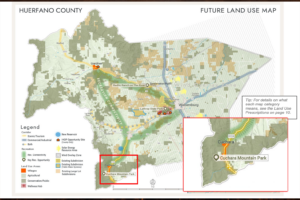 .One of the most significant ideas in the comprehensive plan is the concept of concentrating growth in a few defined “village centers.” The plan identifies Cuchara and Gardner as the county’s two primary village centers outside the incorporated towns of Walsenburg and La Veta. Rather than encouraging scattered development across rural areas, the county intends to focus new growth in these villages where infrastructure and services can be more efficiently supported.(2)
In practical terms, this means the county envisions Cuchara as a compact community where residential areas, small-scale commercial activity, and civic spaces can exist within walking distance. The plan specifically encourages compact, village-style development patterns and prioritizes infill development within existing community boundaries.(3) In simple terms, the county wants future growth to happen within the existing Cuchara village area rather than spreading development into the surrounding mountains.
For residents, this approach has several benefits. Concentrating development helps protect surrounding forests and open spaces while allowing local businesses and services to operate viably. It also reduces the cost of infrastructure expansion for roads, utilities, and emergency services. It has the potential to increase property values close to the village.
Community members can support this strategy by encouraging thoughtful infill development rather than scattered subdivision proposals. Property owners can also support zoning updates that maintain the small-scale character of the village while allowing the kinds of uses that sustain a local economy.
.
Recreation and Tourism as Economic Drivers
.
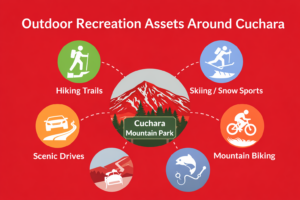 Cuchara’s identity has long been tied to recreation. From the historic Cuchara Camps and the ski area to the trail networks and the growing role of Cuchara Mountain Park, outdoor recreation has shaped the community for generations.
The comprehensive plan explicitly recognizes this. It highlights Cuchara Mountain Park as a key recreation asset and calls for continued implementation of the park’s master plan.(4) The plan also encourages expanded winter sports activities and related amenities as part of the county’s economic development strategy.(5)
This focus reflects a broader understanding that tourism plays a major role in the local economy. Visitors drawn by hiking, snow sports, scenic drives, and events support local restaurants, lodging, and small businesses. Strengthening these recreation opportunities helps sustain the community while maintaining its identity as a mountain destination.
There are several practical ways the community can support this effort. Volunteers can participate in trail maintenance days, park improvement projects, and community events. Property owners can help maintain the appearance of the village and support businesses that serve visitors responsibly. Seasonal residents can also play a role by supporting local organizations that promote recreation and conservation.
.
Transportation and Trail Connectivity
.
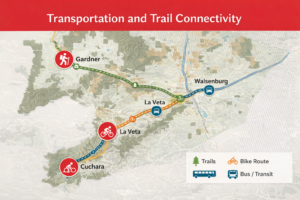 Another major theme in the plan is improving connectivity between communities in the county. The document proposes studying transit options linking Walsenburg and La Veta and notes that such a system could include stops in Gardner and Cuchara.(6)
The plan also calls for the design of off-street multi-use trails in Cuchara, which would improve pedestrian and bicycle access within the village.(7) These trails are envisioned as part of a broader regional network connecting communities and recreation areas.
In addition, the plan references pursuing funding for improvements that would enhance non-motorized travel between Walsenburg, La Veta, and Cuchara through the Southern Mountain Loop concept.(8) If realized, these projects could strengthen the valley’s role as a recreation hub while improving mobility for residents.
Residents can help advance these ideas by participating in public meetings, supporting trail planning efforts, and cooperating with local organizations working on trail connections. Landowners may also have opportunities to grant trail easements or collaborate on community access points.
.
Water Supply: The Defining Constraint
.
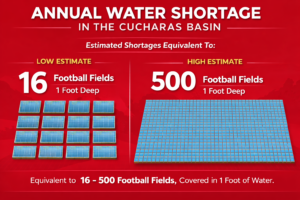 Perhaps the most important issue highlighted in the comprehensive plan is water. The document describes Huerfano County as extremely water-constrained and emphasizes that the Cucharas River Basin faces significant supply challenges.
A study cited in the plan reports that the Cucharas River Basin may experience shortages ranging from approximately 16 to 500 acre-feet per year. (9) To picture this, imagine a football field. The estimated shortage is roughly equal to 16 football fields (low estimate) or 500 football fields (high estimate), each covered with one foot of water.
At the same time, storage capacity in the basin has declined dramatically since World War II, dropping by more than 70 percent, according to the Huerfano Water Conservancy District.(10)
Because of these realities, the plan calls for commissioning a 30-year water supply study beginning in 2025 to better understand future supply and demand.(11) This study will play a major role in determining how much growth the basin can realistically support.
For residents, water stewardship is not just a policy issue. It is a daily responsibility. Practical steps include installing water-efficient fixtures, supporting responsible landscaping practices, and staying informed about local water district planning. Community engagement in water planning discussions will also be essential as new studies and policies emerge.
.
A Plan Built Through Community Effort
.
 It is important to recognize that the comprehensive plan did not emerge from a single office or department. It reflects the work of the Huerfano County Planning and Zoning Commission, the Board of County Commissioners, and numerous community participants who contributed their time and expertise during the planning process.
Their work provides a roadmap that balances growth with conservation, economic opportunity with environmental responsibility, and community identity with long-term sustainability.
For Cuchara residents, the message is clear. The future of the valley will not be determined solely by government policy. It will also be shaped by the everyday decisions of the people who live, work, and spend time here.
Whether maintaining a cabin, supporting local businesses, volunteering on trails, or conserving water, residents play a direct role in implementing the vision described in the comprehensive plan.
The mountains may appear timeless, but the future of the valley depends on thoughtful stewardship today. The comprehensive plan provides a roadmap, but the direction the valley ultimately takes will depend on how its residents choose to engage with that vision.(12)
.
.
Footnotes
Parenthetical numbers in the text (e.g., 5) correspond to the sequentially numbered citations listed below.
1. Huerfano County, Colorado, 2025 Huerfano County Comprehensive Plan and Supporting Materials, available through the Huerfano County Land Use Department website under “2025 County Comprehensive Plan and Supporting Materials,” accessed March 13, 2026, https://huerfano.us/departments/land-use/
2. 2025 Huerfano County Comprehensive Plan Update, Volume 1, Future Land Use Map and village strategy, p. 9–10. https://www.cabininthepines.org/2025_HC_Comprehensive-Plan_V1.pdf
3. 2025 Huerfano County Comprehensive Plan Update, Volume 1, Support Thriving Villages in Huerfano County, p. 10. https://www.cabininthepines.org/2025_HC_Comprehensive-Plan_V1.pdf
4. 2025 Huerfano County Comprehensive Plan Update, Volume 1, Recreation and Trails Policy references to Cuchara Mountain Park, p. 56–59. https://www.cabininthepines.org/2025_HC_Comprehensive-Plan_V1.pdf
5. 2025 Huerfano County Comprehensive Plan Update, Volume 1, Economic Development Action 8.2, p. 45. https://www.cabininthepines.org/2025_HC_Comprehensive-Plan_V1.pdf
6. 2025 Huerfano County Comprehensive Plan Update, Volume 1, Transportation Action 1.1, p. 50. https://www.cabininthepines.org/2025_HC_Comprehensive-Plan_V1.pdf
7. 2025 Huerfano County Comprehensive Plan Update, Volume 1, Transportation Action 4.1, p. 51. https://www.cabininthepines.org/2025_HC_Comprehensive-Plan_V1.pdf
8. 2025 Huerfano County Comprehensive Plan Update, Volume 1, Recreation and Trails Action 5.6, p. 58. https://www.cabininthepines.org/2025_HC_Comprehensive-Plan_V1.pdf
9. 2025 Huerfano County Comprehensive Plan Update, Volume 1, Public Services & Community Safety Key Facts, p. 61. https://www.cabininthepines.org/2025_HC_Comprehensive-Plan_V1.pdf
10. 2025 Huerfano County Comprehensive Plan Update, Volume 1, Public Services & Community Safety Key Facts, p. 61. https://www.cabininthepines.org/2025_HC_Comprehensive-Plan_V1.pdf
11. 2025 Huerfano County Comprehensive Plan Update, Volume 1, Public Services & Community Safety Action 3.1, p. 63. https://www.cabininthepines.org/2025_HC_Comprehensive-Plan_V1.pdf
12. Author’s note: In preparing this article, the author used AI-assisted tools for research support, proofreading, fact-checking, and stylistic refinement. All narrative choices, analysis, and historical interpretations are the author’s own, and responsibility for accuracy rests solely with the author. The blog’s research methodology statement is available at https://cabininthepinescuchara.blogspot.com/2019/03/methodology-sources-and-use-of-research.html
One Response
So will bike and hiking trails be removed from the roadway? The road is already narrow, having bikes and people share the road will lead to someone getting injured or killed.