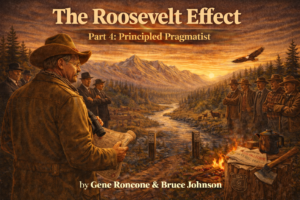
 Theodore Roosevelt was a political paradox. Republicans often distrusted him. Democrats frequently opposed him. Business leaders feared him. Yet the American public admired him.
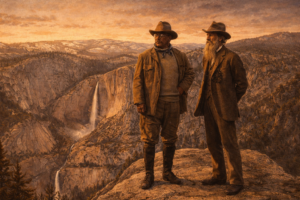
Roosevelt governed as what might best be described as a principled pragmatist. Although known for bold action, his decisions were not impulsive. They were guided by a set of principles that shaped his leadership and repeatedly appeared in his policies, speeches, and political strategy.
In our own day of political gridlock, the politicization of everything, and the death of true collaboration, Roosevelt’s principles can serve us well as individuals, as a mountain community, and as a nation.
1. Steward the Nation’s Resources
Roosevelt believed the nation’s natural resources were not simply commodities for immediate profit but assets held in trust for future generations. This principle guided his conservation policy. Rather than banning all development, he advocated the “wise use” of resources.
 For example, by using the authority granted by the Antiquities Act of 1906, Roosevelt created numerous protected lands.(1) During his presidency, he protected roughly 230 million acres of public land and helped establish the U.S. Forest Service and National Wildlife Refuge System.(2) On June 29, 1906, he signed the act creating Mesa Verde as a national park “to preserve the works of man,” the first U.S. national park explicitly dedicated to protecting archaeological and cultural resources, specifically the cliff dwellings and other sites of the Ancestral Puebloan people in southwestern Colorado.(3)
Mining, timber, and railroad companies had long lobbied both parties for access to these lands. However, Roosevelt believed some landscapes should be preserved as national treasures. His view was simple: responsible use today must not destroy opportunity tomorrow.
This same principle applies to life in the Cuchara Valley. The forests, streams, wildlife, and dark night skies that drew people here remain healthy only through intentional stewardship. Wise use means welcoming recreation and tourism while protecting fragile ecosystems. Decisions about forest management, water use, fire mitigation, and development should consider what the valley will look like fifty or even one hundred years in the future.
The mountains are not the possession of any single property owner but a shared inheritance that we are called to care for together. In that sense, the valley is not something we inherited from the past; it is something we are borrowing from the future.
2. Nation Before Party
Roosevelt believed a president’s primary responsibility was to the nation rather than to a political party or faction. This conviction explains why he often broke with Republican leaders when he felt their policies favored narrow economic interests over the broader public good.
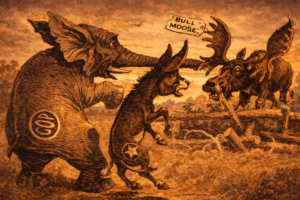 For example, Roosevelt pursued aggressive antitrust actions against monopolies, including the famous case against the Northern Securities Company railroad trust. Many political leaders in both parties were closely tied to big business and opposed such action.
Although he served as a Republican president from 1901–1909, many members of his own party strongly criticized him for his conservation policies.(4) At the time, the Republican Party included several powerful business, mining, railroad, and timber interests, especially in the West. Roosevelt’s conservation program restricted access to resources that many powerful people in his party believed should be developed for economic growth.
Roosevelt’s policies often lead readers to ask whether he would be considered a Democrat or a Republican today. The answer is not simple. Historians often describe him as a “progressive nationalist” or “reform conservative,” a leader who drew ideas from multiple traditions rather than fitting neatly into one party. The difficulty of placing him in today’s political categories reflects his belief that national interest should come before partisan loyalty.
Roosevelt believed the public good must come before political loyalty. That principle has clear meaning in a place like the Cuchara Valley. Small mountain communities function best when neighbors work together even when they hold different political views.
We live in a time when nearly everything is politicized, and arguments are won not by listening, but by vilifying those who hold different opinions. Each day, both sides of the aisle seem to give us someone new to detest. Civility requires focusing on what we have in common rather than our differences. Our valley needs that kind of focus.
Practical challenges such as wildfire prevention, infrastructure, tourism, and conservation require cooperation rather than ideology. Like Roosevelt, communities thrive when people care more about solving problems than winning arguments. In a small mountain valley, neighbors matter more than party labels.
3. A Square Deal for All
Theodore Roosevelt coined the phrase “Square Deal” to describe his belief that government should act as a neutral referee between competing interests in society by preventing abuses of economic power, preserving fair competition, and promoting equal opportunity. He defined it in his 1910 Osawatomie, Kansas speech, saying:
 “When I say I believe in a square deal, I mean not merely that I stand for fair play under the present rules of the game, but that I stand for having those rules changed so as to work for a more substantial equality of opportunity and of reward for equally good service.”(5)
Roosevelt’s Square Deal rested on three priorities: antitrust enforcement, regulation, and conservation. Antitrust meant curbing corporations that abused monopoly power. Regulation meant establishing national rules to ensure major industries operated fairly. Conservation meant the careful management of forests, water, minerals, and wildlife so that future generations would benefit as well.
For example, during the anthracite Coal Strike of 1902, coal miners and mine owners were locked in a bitter conflict that threatened the nation’s winter fuel supply. Previous presidents had typically sided with industrialists. Roosevelt instead brought both sides to the White House and pressured them to negotiate, marking the first time a president intervened in a major labor dispute as a neutral mediator.
Roosevelt’s policies brought him into conflict with some of the most powerful business leaders of his time, including figures such as John D. Rockefeller, J. P. Morgan, Edward H. Harriman, and other powerful railroad and mining interests. (FOOTNOTE 6) His willingness to challenge such influence demonstrated that his goal was not to favor labor or business, but to preserve fairness and stability in the national economy.
Roosevelt believed government should act as a fair referee, balancing competing interests while protecting the public good. That principle applies clearly to life in the Cuchara Valley. The health of the valley depends on fairness between residents, visitors, and the businesses that serve them. Growth should strengthen the community without overwhelming the character that makes the valley unique. At the same time, the shared resources that sustain the valley, including roads, water systems, trails, forests, and wildlife, must be protected for the benefit of everyone.
4. Lead Boldly and Act Decisively
Roosevelt believed leadership required bold initiative rather than cautious passivity. He rejected the idea that presidents should act only when Congress explicitly invited them to do so. He expressed this view in what historians later called the “stewardship theory” of the presidency. According to Roosevelt, the president could act for the public good unless the Constitution or law explicitly forbade it.
“My belief was that it was not only [the President’s] right but his duty to do anything that the needs of the Nation demanded unless such action was forbidden by the Constitution or by the laws,” Roosevelt wrote.(7)
Those who opposed him embraced the Whig theory, a more restrictive view holding that the president may do only what the Constitution or Congress explicitly authorizes.
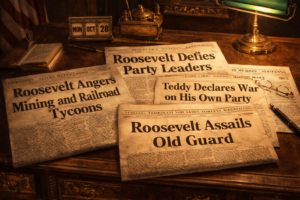 Driven by his conviction that the president must lead rather than merely manage, Roosevelt used executive authority in several significant ways. He intervened in the anthracite coal strike of 1902 by threatening federal intervention and forcing arbitration. He directed the Department of Justice to pursue antitrust suits against major corporations, created the United States Forest Service, and placed roughly 230 million acres under federal management.(8)
He also championed federal food and drug regulation in 1906, supported Panama’s independence from Colombia in order to build the Panama Canal, and demonstrated American naval power by sending the Great White Fleet on a global tour between 1907 and 1909. These examples represent only a portion of Roosevelt’s use of executive authority, which historians widely regard as a defining feature of his presidency.(9)
Roosevelt believed leadership requires initiative and the courage to act before problems become crises. That principle applies clearly to life in the Cuchara Valley. Recently I asked members of several Cuchara and La Veta Facebook groups to share what complex issues they believe will shape the future of the Cuchara Valley. A number of common themes quickly emerged. Water was mentioned repeatedly, particularly concerns about incentivized conservation, availability, and long-term management. Other concerns included the sales tax structure in La Veta, the availability of quality workers for the ski resort, affordable housing, more active and effective local governance, businesses that are strategically aligned with community needs, building a sustainable economy so young people can stay and raise families, resilient forest management, and the growing risk of wildfire.(10)
These are not distant problems for someone else to solve. They are not problems a President, Governor, Senator, or Congress can solve from afar. They are our challenges, and they will require local engagement and collaborative solutions. In many ways, they are exactly the kind of practical issues Theodore Roosevelt would have rolled up his sleeves to tackle if he lived in the valley today.
Those conversations also prompted me to take a closer look at how these same concerns appear in Huerfano County’s Comprehensive Plan, the long-range planning document developed by the county’s planning and zoning committee. (11) While the plan addresses the needs of the entire county, several sections speak directly to issues that affect the Cuchara Valley. For readers interested in how Cuchara fits within that broader county vision, I have summarized those sections in a companion article titled A Local Lens on a Countywide Plan, along with a link to the full Comprehensive Plan for those who wish to explore the document themselves. Understanding how these countywide priorities intersect with life in the valley is one small step toward the kind of informed leadership Roosevelt believed communities need. They are featured with more detail in Journal 92 on this blog.
Small mountain communities cannot afford paralysis or endless delay. Leadership can come from anyone willing to step forward. Those who live here full time cannot do it alone. The many out-of-town property owners who love this valley and enjoy its beauty also have an opportunity to help preserve the land, culture, and history that make the valley so special. Mountain communities endure not by avoiding decisions, but by making them wisely and in time.
5. Take the Case to the People
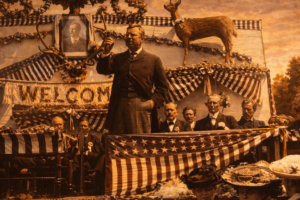 Roosevelt also believed the public must be educated about the critical issues facing the nation. This led him to use his powers of persuasion to take his causes directly to the American people rather than relying solely on Congress, party leadership, or his cabinet.
Historians frequently note that Roosevelt expanded the role of the presidency by using public opinion as a political instrument. Through speeches, press engagement, and national tours, he mobilized citizens in support of his reforms and influenced Congress through his popularity with the public.(12)
He famously described the presidency as a “bully pulpit,” from which to advocate ideas and shape national debate. He used speeches, public events, press statements, and published writings to communicate directly with Americans about issues such as corporate regulation, conservation, and consumer protection. Rather than allowing policy discussions to remain confined to Washington, Roosevelt believed the president had a responsibility to explain national problems to the public and rally support for solutions.(13)
One of his political rivals, Robert M. Follette, said of Roosevelt’s persuasiveness, “He is superb at arousing the public conscience.”(14)
Roosevelt believed leadership should actively engage the public and help citizens understand the issues that shape their future. That same principle also applies to life in the Cuchara Valley. Strong communities grow when people stay informed about local concerns and participate in preserving and improving the place they share.
Volunteer fire departments, community organizations, and local initiatives all depend on citizens willing to contribute their time and attention. Sharing the history, culture, and conservation efforts of the valley also strengthens a sense of identity and common purpose. When people are informed, involved, and invested, communities are better equipped to make wise decisions about their future.
The Roosevelt Effect and the Cuchara Valley
Roosevelt believed the character of a nation was revealed by how its people used their resources, how they treated one another, and whether they had the courage to act when action was required.
Those same questions apply to small mountain valleys just as much as to great nations. The Cuchara Valley we leave to the next generation will depend on how well we live out these principles today.(15)
Companion Video
His boots may never have pressed our trails, but his decisions in Washington drew the boundary lines that still protect the mountains rising above our cabins today. His impact continues to stand over us in five ways. Lets talk about it.
Footnotes
Parenthetical numbers in the text (e.g., 5) correspond to the sequentially numbered citations listed below.
1. The Antiquities Act of 1906 authorized presidents to create national monuments to protect sites of historic or scientific interest. U.S. National Park Service, “The Antiquities Act of 1906,” National Park Service, accessed March 7, 2026, https://www.nps.gov/subjects/archeology/antiquities-act.htm
2. “Theodore Roosevelt and Conservation,” National Park Service, last updated November 15, 2017, https://www.nps.gov/thro/learn/historyculture/theodore-roosevelt-and-conservation.htm
3. “Mesa Verde National Park: World Heritage Site,” National Park Service, last updated July 5, 2020, https://www.nps.gov/articles/000/mesa-verde-national-park-colorado.htm
4. Lewis L. Gould, The Presidency of Theodore Roosevelt (Lawrence: University Press of Kansas, 1991), 86–101. https://archive.org/details/presidencyoftheo0000goul
5. Theodore Roosevelt, speech in Osawatomie, Kansas, August 31, 1910, in The New Nationalism speech text, Teaching American History, https://teachingamericanhistory.org/document/the-new-nationalism-50/
6. Roosevelt stood firm in the face of opposition from some of the most powerful entrepreneurs of his era, including John D. Rockefeller (Standard Oil), J. P. Morgan (finance, U.S. Steel, and railroads), the Vanderbilt family (major railroads), and Edward H. Harriman (Union Pacific, Southern Pacific, and Central Pacific railroads). The list also includes James J. Hill (Great Northern Railway and Northern Securities), Frederick Weyerhaeuser (timber industry), the Guggenheim family interests (copper and silver mining and smelting), Senator William A. Clark (Montana “Copper King”), and F. Augustus Heinze (Montana copper baron).
7. Theodore Roosevelt, Theodore Roosevelt: An Autobiography (New York: Charles Scribner’s Sons, 1913), 388. https://www.gutenberg.org/ebooks/3335
8. U.S. Fish and Wildlife Service, “Theodore Roosevelt (1858–1919): Conservation President,” accessed March 10, 2026, https://www.fws.gov/staff-profile/theodore-roosevelt-1858-1919-conservation-president
9. “President Theodore Roosevelt Executive Orders,” ConservativeUSA, accessed March 10, 2026, https://www.conservativeusa.net/eo/troosevelt.htm.
10. Responses were collected from community discussions in several Cuchara and La Veta Facebook groups during informal outreach conducted by the author the week of March 9, 2026.
11. Huerfano County, Colorado, 2025 Huerfano County Comprehensive Plan and Supporting Materials, available through the Huerfano County Land Use Department website under “2025 County Comprehensive Plan and Supporting Materials,” accessed March 13, 2026, https://huerfano.us/departments/land-use/
12. Edmund Morris, Theodore Rex (New York: Random House, 2001), 70–72.
13. Theodore Roosevelt, Theodore Roosevelt: An Autobiography (New York: Charles Scribner’s Sons, 1913), 388–389, https://www.gutenberg.org/ebooks/3335
14. Garraty, John A. “La Follette: The Promise Unfulfilled.” American Heritage 13, no. 3 (April 1962). https://www.americanheritage.com/la-follette-promise-unfulfilled.
15. Author’s note: In preparing this article, the author used AI-assisted tools for research support, proofreading, fact-checking, and stylistic refinement. All narrative choices, analysis, and historical interpretations are the author’s own, and responsibility for accuracy rests solely with the author. The blog’s research methodology statement is available at https://cabininthepinescuchara.blogspot.com/2019/03/methodology-sources-and-use-of-research.html