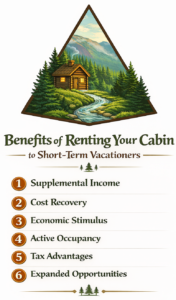
 Most cabin owners do not lie awake wondering how to turn their place into a business. They lie awake wondering how to protect it, pay for it, upgrade it, and keep it part of the family for years to come. Gene Roncone and Ed Matthes wrap up this two-part series by sharing three more reasons that matter most to cabin owners.
 In the first part of this two-part series, we looked at three of the most visible benefits of renting your cabin when it is not in use: supplemental income, cost recovery, and the broader economic boost renting your cabin to vacationers brings to the Cuchara Valley. Together, those benefits answer a practical question many owners quietly ask themselves: Does renting my cabin really make sense? But income and economics are only part of the story.
 In this second part, we turn to three additional benefits that are often less obvious but just as meaningful, especially for owners who care deeply about protecting their cabin and planning for the long term. These next advantages focus on what regular use does for the physical health of a mountain home, how active occupancy can reduce risk and prevent costly surprises, and how federal tax law quietly rewards owners who place their property into rental service.
Taken together, these benefits move the conversation beyond dollars earned and into peace of mind, stewardship, and smart planning. They explain why many long-time cabin owners eventually discover that renting is not just a financial decision, but a practical way to care for the place they love. “Most owners don’t come to renting because they want to maximize income. They come to it because they want their cabin to last, and they want it cared for when they can’t be there.”, said Ed Matthes.
We begin with one of the most overlooked advantages of all: what happens when a cabin is no longer sitting empty.
4. Active Occupancy
 Cuchara, Colorado experiences long, high-altitude winters, with average January temperatures dipping to around 15°F at night and rising to only about freezing during the day.(1) In conditions like these, leaving a cabin unoccupied for extended periods can invite a wide range of preventable problems.
Industry data show that vacant homes are far more likely to suffer damage or loss from frozen or leaking pipes, undetected electrical issues, an increased risk of break-ins or vandalism, roof and wind damage, and wildlife intrusion when compared with homes that are regularly occupied.(2 & 3)
A cabin that is in use is also far less likely to experience a breakdown that goes unnoticed. When people are staying at the property, small issues tend to be discovered early, before they escalate into costly emergencies. If a water heater or baseboard heating system fails, or a pipe begins to leak, an occupant can spot the problem quickly and shut off the water or request repairs. In an empty cabin, that same issue could go undetected for days or even weeks, potentially leading to flooding, mold growth, or structural damage.(4) As the owner of a long-standing cabin rental company, Ed Matthes has seen this reality play out firsthand. “In our experience, the most expensive problems usually occur in cabins that sit empty the longest. You’d be shocked by the difference between a cabin that sits unused for months and one that’s regularly occupied. Even after all these years, I’m still surprised by how quickly things wear out when they aren’t used. When a property is used regularly by guests or cleaners, problems surface sooner, and small issues are often caught before they become big ones,” he said. If you’re prone to catastrophic rumination, Ed has listed some of his very real nightmares dealing with the wear, tear, and surprises of unused property in the footnotes.(5)
 Even intermittent occupancy helps discourage rodent and pest infestations. Animals seeking warmth are less likely to settle in a cabin that shows signs of human activity and are more likely to be noticed and addressed quickly if they do attempt to move in.
By contrast, a lived-in cabin, even one occupied periodically by responsible renters, tends to remain safer and better maintained overall. Owners also gain peace of mind knowing that if a problem does arise, a local property manager can respond quickly and coordinate repairs without delay. According to Ed Matthes, most issues don’t require anything dramatic—just someone local who can respond quickly, make a call, and keep a small problem from escalating. “Many issues simply don’t surface when an owner uses a property for an occasional weekend. Regular use is what makes things like a slow leak noticeable,” he said.
Viewed as a whole, renting your cabin to vacationers can serve as a practical strategy for protecting your investment and maintaining your mountain retreat throughout the year. And once those protective benefits are in place, the financial advantages become even more compelling, particularly when you consider the favorable tax treatment that often comes with renting a cabin.
5. Tax Advantages
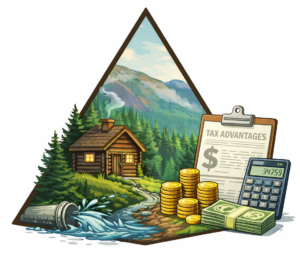 One of the most concrete benefits of renting out a cabin is the favorable tax treatment that comes with being classified as a rental property under federal tax law. When you rent out your cabin, the Internal Revenue Service generally treats it as rental real estate rather than simply a personal second home. That distinction is important. It opens the door to a set of deductions built around a core principle of the tax code: expenses incurred to produce income should be recognized.(6)
Once your cabin is placed into rental service, many everyday ownership costs can be treated as deductible business expenses. These typically include maintenance and repairs, cleaning and guest turnover costs, utilities such as electricity, water, propane, and internet, property insurance, HOA dues if applicable, and fees paid to property managers or booking platforms. These expenses are deducted against rental income, reducing the amount subject to taxation. For example, if your cabin earns $12,000 in rental income but incurs $7,000 in deductible expenses, you are taxed only on the remaining $5,000.(7)
 In addition, depreciation is often the single largest tax benefit available to cabin owners who rent. The IRS allows owners of residential rental property to deduct the gradual wear and tear of the structure, excluding the land value, over a 27.5-year period.(8) What makes depreciation especially powerful is that it reduces taxable income without requiring any out-of-pocket cash expense in the year it is claimed. As a result, a cabin can generate positive cash flow while still reporting little or even no taxable income on paper. This dynamic is one of the primary reasons real estate is widely viewed as a tax-efficient asset class.(9) Over the years, Ed has seen this benefit play out firsthand. “The tax benefits are real, but they work best for owners who understand the rules and plan ahead. The owners who benefit most treat renting as a long-term strategy, not a one-year experiment. Every financial situation is different, and thoughtful planning can significantly maximize the benefits,” he said.
If your cabin is financed, the interest portion of mortgage payments is generally deductible as a rental expense. Property taxes attributable to the rental use of the cabin are also deductible.(10)
When a cabin is used both personally and as a rental, the IRS requires expenses to be allocated proportionally based on the number of days the property is rented versus the number of days it is used personally.(11)
Trips to your cabin that are primarily related to rental activity, such as repairs, inspections, maintenance, or managing improvements, may also qualify for deductible travel or mileage expenses, depending on the facts and documentation.(12) These deductions do not apply to purely recreational visits, but they do acknowledge that managing a rental property often requires hands-on involvement.
Every cabin owner’s financial situation is different. Income levels, personal use patterns, financing structures, and management involvement all influence how these rules apply. While the tax advantages of renting a cabin can be substantial, decisions should always be made in consultation with a qualified tax professional or CPA who can evaluate your specific circumstances and ensure compliance with current tax law.(13) And these are not the only tax-related benefits available to cabin owners.
Beyond protection and tax efficiency, another trend is quietly reshaping what cabin ownership looks like in Cuchara.
6. Expanding Opportunity
 For generations, Cuchara has drawn visitors looking for something simple and restorative: majestic mountainscapes, quiet cabin stays, clear mountain air, good fishing, and trailheads that begin just beyond the front porch. In recent years, that appeal has only grown, as more travelers seek private cabins and vacation homes instead of traditional hotels. This shift in how people travel has placed the Cuchara Valley squarely in their sights and increased demand for short-term rentals.
For cabin owners, this creates a rare balance of heart and practicality. Your cabin can remain the personal mountain refuge it has always been, while also becoming a reliable source of rental income. Participating thoughtfully in this growing market can help offset the real costs of ownership, open the door to meaningful returns, and still leave plenty of time for your own family to enjoy the place. As Cuchara’s appeal continues to rise, owners who step into this opportunity now are well positioned to benefit for years to come.(14)
Together, these six benefits show how renting your cabin can support your finances, protect your property, and strengthen the community you care about.
Footnotes
Parenthetical numbers in the text (e.g., 5) correspond to the sequentially numbered citations listed below.
1. Weather Atlas, “Climate and Monthly Weather Forecast: Cuchara, CO,” Weather-Atlas.com, updated February 10, 2024, https://www.weather-atlas.com/en/colorado-usa/cuchara-climate
2. Berlin Insurance Group, “Summer Insurance Prep: Protecting Your Home during Vacation Season,” June 2, 2025, BerlinInsuranceGroup.com, https://berlininsurancegroup.com/summer-insurance-prep-protecting-your-home-during-vacation-season/
3. DAWGS Security for Vacant Property, “Securing Vacant Property During Winter Months: A Comprehensive Guide,” December 4, 2023, DAWGS Inc., https://www.dawgsinc.com/securing-vacant-property-during-winter-months-a-comprehensive-guide/
4. DAWGS Security for Vacant Property, “Securing Vacant Property During Winter Months: A Comprehensive Guide,” December 4, 2023, DAWGS Inc., https://www.dawgsinc.com/securing-vacant-property-during-winter-months-a-comprehensive-guide
5. Special Footnote: Real Stories of Vacant Properties. Over more than two decades of managing properties in Cuchara, Ed Matthes has seen firsthand how vacant cabins can quietly deteriorate in ways that surprise even experienced owners. What appears to be a peaceful, untouched property often hides problems that only surface when no one is around to notice them.
In one case, Ed entered a cabin for a routine walkthrough in December and, by sheer chance, discovered that a baseboard heater had shorted and caught fire while he was inside. The timing was pure luck. Had the property not been checked regularly, the outcome could have been catastrophic.
Other situations have been far less forgiving. Ed recalls walking into a home during sub-zero temperatures where a toilet had begun running while the sewer line outside was frozen solid. With nowhere for the water to go, it overflowed and traveled through the house, turning a simple mechanical failure into widespread damage.
Even small, everyday components can fail dramatically when left unused. Faucets that are not turned on or off for months can dry out internally, causing valve seats to crack or deform and eventually leak. Minor issues like a slow drip or a broken board, when unnoticed, can escalate from a simple repair into thousands of dollars in damage.
Winter introduces its own risks. Ice damming is a persistent issue in Cuchara, and Ed has seen situations where newly installed roofs trapped ice beneath shingles, only for it to melt and seep down onto hardwood floors below—often discovered long after the damage had begun.
Wildlife also takes advantage of vacant homes. Packrats, in particular, are drawn to empty properties, where they have uninterrupted time to chew through walls, flooring, and electrical wiring, creating entry points and extensive damage before anyone realizes they are there.
Drawing on more than 20 years of property management experience, several years owning a home repair business, and countless informal calls to “lend a hand,” Ed has reached a consistent conclusion: vacant properties require exponentially more repairs and hands-on work than those that are used and monitored regularly.
6. Internal Revenue Service, Residential Rental Property (Including Rental of Vacation Homes), IRS Publication 527, https://www.irs.gov/publications/p527.
7. Internal Revenue Service, Rental Income and Expenses, IRS Topic No. 414, https://www.irs.gov/taxtopics/tc414.
8. Internal Revenue Service, Depreciation, IRS Publication 946, https://www.irs.gov/publications/p946.
9. Internal Revenue Service, Depreciation of Rental Property, https://www.irs.gov/businesses/small-businesses-self-employed/depreciation-of-rental-property.
10. Internal Revenue Service, Mortgage Interest and Property Taxes, IRS Publication 527, https://www.irs.gov/publications/p527.
11. Internal Revenue Service, Vacation Homes and Mixed-Use Property, IRS Publication 527, https://www.irs.gov/publications/p527#en_US_2023_publink1000219233.
12. Internal Revenue Service, Travel Expenses, IRS Publication 463, https://www.irs.gov/publications/p463.
13. The content in this article does not constitute legal or tax advice. Although the author has made every effort to ensure that the information in this resource was correct at the time of release, the authors do not assume and hereby disclaim any liability to any party for any loss, damage, or disruption caused by errors or omissions, whether such errors or omissions result from negligence, accident, or any other cause. The reader should consult with an attorney, CPA, or other tax professional in matters relating to renting their cabin.
14. Author’s note: In preparing this article, the author used AI-assisted tools for research support, proofreading, fact-checking, and stylistic refinement. All narrative choices, analysis, and historical interpretations are the author’s own, and responsibility for accuracy rests solely with the author. The blog’s research methodology statement is available at https://cabininthepinescuchara.blogspot.com/2019/03/methodology-sources-and-use-of-research.html