
Imagine stepping off a dusty wagon, the scent of pine and woodsmoke thick in the air. Around you, canvas tents line the river, children race along narrow trails, and George Mayes waves from the porch of a rustic lodge, offering a hand and a promise: “You’ll sleep better here than you have in years.”
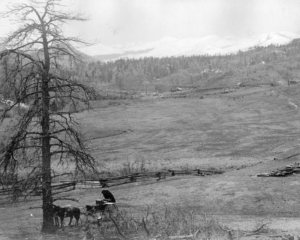 Scenes like this were not imagined. They defined the early years of what became known as Cuchara Camps, a place that would play a central role in shaping both the Cuchara Valley and the future Pinehaven community.
In the early 1900s, rows of canvas tents lined the Cucharas River, drawing visitors eager to escape the summer heat. Word of the valley’s breathtaking beauty and cool mountain air spread quickly, sparking a wave of interest that helped place Cuchara on the map.
This journal contends that Cuchara Camps did more than attract visitors. It transformed health-seeking travelers into returning guests and, ultimately, landowners through thoughtful amenities, intentional community-building, and effective and innovative advertising. It also introduces an important connection to Pinehaven, rooted in the Powell family’s involvement during the 1930s.
From Healing to Vision
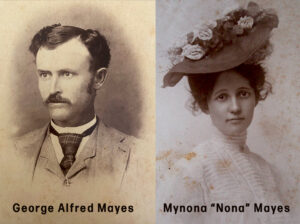 During the summer of 1906, George Mayes, a grocer and farmer from Collin County, Texas, traveled through Colorado in search of a mountain haven where he and his ailing brother could find relief.(1)
Struggling with health issues himself, Mayes was drawn to the region’s thin, clean air, long praised for its renewing powers. Though George A. Mayes, founder of Cuchara Camps, was occasionally referred to as “Doctor” in early accounts, no record confirms that he held a medical degree. The title likely arose from confusion with his brother, Walter C. Mayes, a trained physician who frequently visited Cuchara and was documented in newspapers of the time.(2) What began as a search for healing soon became the driving force behind his move to the Cuchara Valley.
When he arrived, Mayes saw more than a place to recover: cool air, pine-covered hills, and the clear-running waters of the Cucharas River. He recognized the valley’s potential as a mountain retreat for others seeking the same relief.
He and his wife, Nynona “Nona” Mayes, wasted no time securing the property. They acquired a modest five-room ranch house associated with the W. J. Gould Ranch, a 160-acre tract near the Cucharas River.
Local histories often simplify the purchase as a direct 1906 sale from William J. Gould. County deed records suggest a two-step transfer instead: Gould conveyed the ranch to Charles M. Mack in 1907, and Mayes operated the property while Mack held title until a 1910 warranty deed transferred ownership to Mayes.(3) The story behind this transaction, including the original documents, is explained in Journal 79 as well as a short video documentary linked in the footnotes.(4)
From Tents to Cabins
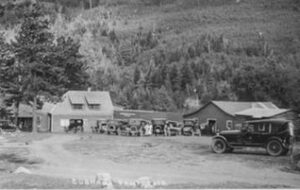 Mayes began by expanding the old Gould ranch house, adding a few rooms to the existing 32-by-32-foot structure, and began renting out rooms to summer visitors.(5)
By 1908, he was expanding beyond tents, constructing simple one- and two-room cabins, often called cottages or shacks, each with a sleeping porch and basic facilities. These offered guests a modest but comfortable mountain stay.(6)
The early accommodations were rustic, to say the least. In River of Friendship, Hazel Cross and Josephine C. Jochem offer a vivid description:
“He also hastily threw together a few one- and two-room cabins (as one early comer said, ‘shacks, and I mean shacks’), rudely built, unpretentious, with no screens and leaky roofs. Some had fireplaces, all had small wood-burning cookstoves, coal oil lamps, a bed or two, a table and chairs, and a few pans and dishes. Even so, they provided summer camping quarters along Dodgton Creek, where cold water was plentiful. A few years later, with the financial assistance of Senator Adolph Unfug, he built a small water system and installed a Delco lighting plant, which furnished one drop light (60-watt) per cabin.”(7)
Mayes continued to develop the property into a rustic mountain retreat, expanding lodging and offering guests everything from camping gear to guided adventures. To make fishing a prime attraction, he stocked nearby lakes with trout. He also introduced burros and saddle horses for scenic rides, while maintaining the charm of the early camp experience.(8)
In those early years, guests arrived by carriage or wagon, and even as automobiles began to appear, the appeal of horseback travel remained a defining part of the experience.(9)
Mayes’s goal was simple: keep visitors satisfied so that some would later purchase land or build cabins of their own.
A Camp Comes to Life
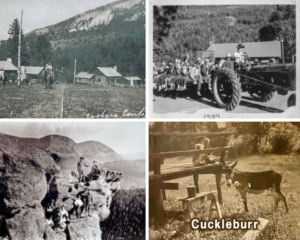 By lamplight, the dance pavilion came alive each weekend. Fiddles played familiar square tunes alongside newer “modern” steps. Guests swapped stories, sang under the stars, and found community in the glow of lanterns flickering against the pines.(10)
A small café served meals, and George operated a camp store stocked with basic groceries, cold drinks, fishing gear, and other necessities. Campfires became a focal point in the evenings, where guests gathered for trout fries, sing-alongs, and wiener roasts beneath the mountain sky.
George’s philosophy was simple. If visitors were kept happy with wholesome recreation, they might one day purchase a cabin or property of their own.
Ever the innovator, Mayes also looked beyond rustic charm. Partnering with Senator Adolph Unfug, he developed a small water system and introduced electricity through a Delco lighting plant, giving each cabin a warm 60-watt glow. (11)
Cuchara’s Marketing Marvel
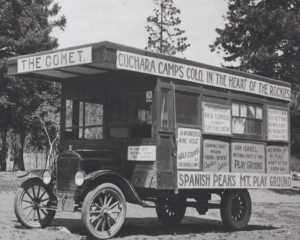 One of Mayes’s most inventive ideas was his homemade “advertising truck,” a practical and eye-catching tool that carried the story of Cuchara Camps far beyond the valley.(12) Long before modern RVs or mobile billboards, Mayes transformed a simple 1925 Ford Model TT truck into a traveling advertisement, complete with slogans and cabin scenes that carried the dream of Cuchara Camps from town to town and nearby states.(13)
Cabin in the Pines recently uncovered the original bill of sale for a 1925 Ford Model TT purchased in La Veta. The document confirms the truck’s engine number and identifies George A. Mayes as the owner, establishing the vehicle as a verified artifact tied directly to the early development of Cuchara.(14)
The resort’s reputation spread by word of mouth and local press. Beginning in 1909, the La Veta Advertiser newspaper even ran a dedicated column titled “Cuchara Camps Notes” each summer, reporting on camp arrivals, activities, and weather. This indicates Cuchara’s prominence in local society.(15) By the 1920s, the camp had many more cottages, a small golf course in the meadow, and an official post office with George’s wife Nona Mayes appointed as the first postmaster.(16) They also had a clubhouse with a flower garden at the nearby Blue Lake Camp area.(17)
The Camp that Became a Village
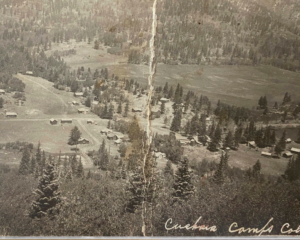 In 1916, a U.S. post office named “Cuchara Camps” was established on what is now Cuchara Avenue, formally anchoring the name of the area. In 1957, the name was shortened to simply “Cuchara,” reflecting its transition from a seasonal camp into a permanent village.(18)
By the close of 1924, Cuchara Camps had blossomed into a lively mountain village, with more than forty private cottages nestled around its heart—with new construction contracts already in hand. It was clear that Mayes’s vision had grown from a hopeful experiment into a thriving enterprise.(19)
In retrospect, this represented formal recognition by both local and federal authorities of a community already taking shape. The establishment of a post office and the likely naming of Cuchara Avenue played a pivotal role in transforming Cuchara Camps into a permanent village.
Cuchara Takes Shape
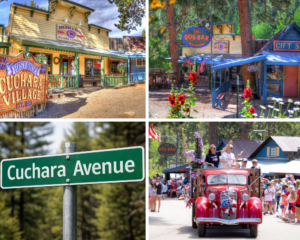 From the 1920s through the 1940s, Cuchara Camps entered a period of transition and continued growth. Mayes died on February 27, 1930, bringing the resort’s founding era to a close. (FOOTNOTE 20) In the years that followed, ownership changed hands, and subsequent proprietors continued to build upon the foundation he had established.(21)
One of the most historically significant connections between Cuchara Camps and Pinehaven emerges through the Powell family. In 1931, local news reports stated that Charles Rutherford Powell, son of Charles Lloyd Powell, the original homesteader of the land that would later become Pinehaven, purchased Cuchara Camps.(22) This transfer helps explain how people and investment networks overlapped between the emerging village and nearby cabin communities.
As the community matured, Cuchara’s growth took on a more defined shape. Small and cozy cabin communities began to emerge, and developments such as Spanish Peaks subdivision brought additional momentum to the valley.(23)
Life in Cuchara during these years was defined as much by its social fabric as by its physical development. Local newspapers describe a lively scene filled with burro rides, Saturday night dances, impromptu talent shows, musicals, and masquerade parties, often illuminated by kerosene lamplight.(24)
Infrastructure improvements followed as the village continued to develop. A 1936 news report notes that Charles R. Powell purchased a power plant to bring electricity to the resort.(25) When later research sought to pinpoint the location of the old dance hall and the “power plant,” Fire Chief Ron Jameson, whose family roots in the Cuchara Valley go back seven generations, laughed and offered a more grounded perspective. “Power plant?” he said. “Those were two hand-crank generators shoved into a shed the size of a walk-in closet, right about where the Cuchara Yacht Club sits today. And I’m pretty sure one of ’em needed a coffee break every now and then.”(26)
By the mid-20th century, access to the valley had improved significantly. In 1964, the paved Highway 12, known as the Highway of Legends, was completed over Cuchara Pass, further accelerating growth and opening the area to a wider range of visitors.(27) These developments laid the groundwork for Cuchara’s modern infrastructure and its continued appeal as a mountain retreat.(28)
Who Could Have Imagined
The development of Cuchara Camps served as a catalyst for the valley’s transformation, shaping both its growth and its enduring identity as a sought-after mountain destination. If William Gould could step forward in time, he would see that the quiet dirt driveway to his ranch has become something far greater than a road. It has become Cuchara Avenue, a place where travelers gather, stories are shared, and a simple path to one man’s home has turned into the heart of a community.(29)
← View Cuchara Camps Historical Pictures
Footnotes
Parenthetical numbers in the text (e.g., 5) correspond to the sequentially numbered citations listed below.
1. Cabin in the Pines, “Journal 58: A Biography of George Alfred Mayes,” accessed March 25, 2026, https://cabininthepines.org/journal-58-a-biography-of-george-alfred-mayes/
2. Pinehaven Cuchara, “Was George Mayes, The Founder of Cuchara Camps, A Doctor?” YouTube video, posted November 6, 2025, https://www.youtube.com/watch?v=XgadgF4ugek
3. Although often described in local histories as a direct 1906 purchase from William J. Gould, county records reveal a more complex transaction. George A. Mayes did not acquire the former Gould Ranch through a single, direct conveyance from Gould, but through a two-stage, privately financed arrangement. In October 1907, William J. Gould and his wife conveyed the ranch to Charles M. Mack by warranty deed. Mack subsequently entered into a seller-financed purchase agreement with Mayes, retaining legal title while Mayes assumed possession and began development of the property, as evidenced by contemporaneous mortgage and deed of trust filings covering land described as Sections 3 and 4, Township 31 South, Range 69 West. Full legal ownership passed to Mayes on December 6, 1910, when Mack executed a warranty deed conveying title, completing the transaction.
4. “Untangling the Confusion About Cuchara Camps Land Purchase,” YouTube video, Pinehaven Cuchara, dated December 28, 2025, https://youtu.be/Yu4r5W5qxac and documents at https://cabininthepines.org/journal-79-untangling-the-confusion-about-the-cuchara-camps-land-purchase/
5. “Way Back When in Cuchara Camps,” The World Journal, accessed October 31, 2025, https://worldjournalnewspaper.com/way-back-when-in-cuchara-camps/
6. “Way Back When in Cuchara Camps,” The World Journal, accessed October 31, 2025, https://worldjournalnewspaper.com/way-back-when-in-cuchara-camps/
7. Hazel E. Cross and Josephine C. Jochem, River of Friendship (Chicago: Adams Press, 1970), 17
8. “Way Back When in Cuchara Camps,” The World Journal, accessed October 31, 2025, https://worldjournalnewspaper.com/way-back-when-in-cuchara-camps/
9. “Way Back When in Cuchara Camps,” Huerfano World Journal, accessed March 25, 2026, https://worldjournalnewspaper.com/way-back-when-in-cuchara-camps/
10. “Way Back When in Cuchara Camps,” The World Journal, accessed October 31, 2025, https://worldjournalnewspaper.com/way-back-when-in-cuchara-camps/
11. Hazel E. Cross and Josephine C. Jochem, River of Friendship (Chicago: Adams Press, 1970), 17
12. Cuchara Foundation, “Cuchara Digital History Project,” accessed June 12, 2025, https://www.cucharafoundation.org/cuchara-digital-history-project; Cuchara Foundation, Facebook page, accessed June 12, 2025, https://www.facebook.com/CucharaFoundation/; Cuchara Foundation, photograph, Facebook, https://www.facebook.com/photo?fbid=536982096443121&set=a.235326319942035
13. Gene Roncone and Rhonda Roncone, “Journal 60: Wheels of Change: The Truck That Drove Cuchara’s Future,” Cabin in the Pines: History and Happenings of Pinehaven by Gene & Rhonda Roncone (blog), December 1, 2020, accessed October 31, 2025, https://cabininthepinescuchara.blogspot.com/2020/12/journal-60-wheels-of-change-truck-that.html
14. Bill of sale for 1925 Ford Model TT purchased in La Veta by George A. Mayes, photograph, accessed March 25, 2026, https://photos.google.com/share/AF1QipPOPdKgKThIxNdGX1tbWj1rLgdgQdNwKM7-opUfGezKJvB_0jAJoDoZbeNZPuLRgQ?key=LWtJSXNSWnBKblozcEdkZWYzV3UxcklsSm5UWlZ3. Further explanation can be found in Journal 60: Wheels of Change: The Truck That Drove Cuchara’s Future at https://cabininthepines.org/journal-60-wheels-of-change-the-truck-that-drove-cucharas-future/
15. “Way Back When in Cuchara Camps,” The World Journal, accessed October 31, 2025, https://worldjournalnewspaper.com/way-back-when-in-cuchara-camps/
16. Karen Mitchell, “Huerfano County News 1915,” Huerfano County, Colorado — Genealogy & History Web Site, accessed October 31, 2025, https://www.kmitch.com/Huerfano/news1915.html#:~:text=1916%20February%20La%20Veta%3A%20A,20%20to%20Mr
17. Nancy Christofferson, “Regional History – One Wild Playground,” The World Journal, accessed October 31, 2025, https://worldjournalnewspaper.com/regional-history-one-wild-playground/
18. Mitchell, Karen. “Huerfano County, Colorado History: The Century.” Accessed June 7, 2025. https://www.kmitch.com/Huerfano/century.html This source confirms that the “Cuchara Camps” post office was established in 1916, and provides historical context of the post office name being shortened to just “Cuchara” in 1957.
19. Nancy Christofferson, “Regional History – One Wild Playground,” The World Journal (La Veta, Colorado), accessed October 31, 2025, https://worldjournalnewspaper.com/regional-history-one-wild-playground/
20. Nancy Christofferson, “This Week in History for February 27, 2019,” World Journal, February 27, 2019, https://worldjournalnewspaper.com/this-week-in-history-for-february-27-2019-by-nancy-christofferson/#:~:text=1930:%20Died%2C%20George%20Alfred%20Mayes (noting the death of George Alfred Mayes on February 27, 1930).
21. Cuchara Foundation, “About Us,” accessed June 12, 2025, https://www.cucharafoundation.org/cuchara-village
22. Huerfano County News, “La Veta News,” March 1931 (“Charlie Powell plans to buy Cuchara Camps, pending settlement of the Mayes estate”) and June 1931 (“Charles Powell now is the owner of Cuchara Camps”), compiled in Karen Mitchell, Huerfano County News Articles 1930–1934, accessed June 7, 2025, https://www.kmitch.com/Huerfano/news1930.html
23. Cuchara Foundation, “Cuchara Digital History Project,” accessed June 12, 2025, https://www.cucharafoundation.org/cuchara-digital-history-project
24. Nancy Christofferson, “Way Back When in Cuchara Camps,” World Journal, accessed June 7, 2025, https://worldjournalnewspaper.com/way-back-when-in-cuchara-camps/
25. Huerfano County News, June 1936: “La Veta Light, Heat and Power Sold a $1,500 Power Plant to Charles R. Powell with Which to Electrify Cuchara Camps,” Huerfano County News Articles 1930s, accessed June 7, 2025, https://www.kmitch.com/Huerfano/news1935.html
26. Ron Jameson, interview by author, Cuchara, Colorado, June 22, 2025.
27. Colorado Department of Transportation, “State Highway History and Development,” accessed March 25, 2026, https://www.codot.gov
28. Cuchara.org, “About Us,” accessed March 25, 2026, https://www.cuchara.org/about-us/
29. Author’s note: In preparing this article, the author used AI-assisted tools for research support, proofreading, fact-checking, and stylistic refinement. The narrative, analysis, and historical interpretations are the author’s own, and responsibility for accuracy rests solely with the author. The blog’s research methodology statement is available at: https://cabininthepines.org/journal-81-methodology-sources-and-use-of-research-tools/