

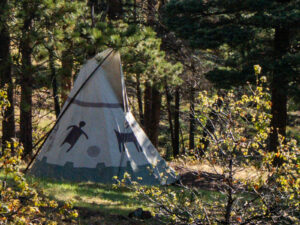
In the forest beyond the end of Road 405, near Pinehaven’s limited-access fire road, an authentic tipi is raised every year between May and November. The tradition began with former Pinehaven cabin owners Charles and Linda Chauvin, who raised the tipi as a tribute to the Ute people who called these mountains home. Charles Chauvin purchased and assembled it while he owned the cabin at 113 County Road 405.
 For more than two decades, Charles and Linda Chauvin faithfully invested their time and talents in Pinehaven. They have long since moved away, yet the tipi is still there. I recently tracked Charles down and asked about the tipi’s origin.
“I was inspired by going through the Francisco Fort Museum in La Veta. There is a letter there written by ranchers complaining about the Utes camping on their property like ‘it was theirs,’” Chauvin said. Chauvin’s recollection of the museum exhibit closely parallels an 1873 incident described by Nancy Christofferson, who wrote that settlers reported the Utes were “claiming the country as their own” and regarded the white settlers as “trespassing.”(1)
Charles explained that the museum letter inspired him to purchase the tipi as a personal reminder that the Ute people had called these mountains home long before Pinehaven existed.(2) He purchased a full-sized tipi modeled after those traditionally used by the Ute people from the Colorado Yurt Company in Montrose, Colorado.(3)
Charles eventually moved from Pinehaven, and with him went the tipi. But the story didn’t end there. After relocating to La Veta and displaying it for several years, he gave the tipi to Steve and Bridget Johnson, the new owners of his former Pinehaven cabin. Today, each spring, the Johnsons once again raise the tipi beneath the pines from May to November.(4) They do this not because they have to, but because they have chosen to continue a tradition of remembering those who walked these mountains long before Pinehaven existed.
.
What can we learn from the Chauvins and the Johnsons?
.
We are stewards of stories that began before us. Pinehaven’s history did not begin with its cabins or present owners. The tipi reminds us that each generation inherits a place with an existing story and has a responsibility to preserve it. It is easy to unconsciously treat the history of a place as though it began with our own arrival. We must remember that each of us is a microscopic dot on the timeline of history, not its center.
We honor the past by making it visible in the present. Each time the tipi is raised in Pinehaven, the past is brought into the present and made harder to overlook. In a different but similar way, we “raise tipis” by listening to someone else’s story long enough to be able to tell it ourselves. We raise tipis by preserving valuable parts of our past, honoring older generations, and uncovering the wisdom hidden within their stories to help us better navigate the future.
Remembering is one of the truest forms of humility. In this case, Charles’s decision to purchase and raise the tipi each year, and the Johnsons’ decision to continue erecting it, direct attention beyond themselves and toward a much older history of the land. Raising a metaphorical tipi decenters us and acknowledges that others matter as much as we do. It recognizes that we inherited more than we created and gives honor without expecting recognition.
One of the most meaningful details about the tipi is its secluded location at the end of a forest road, nearly hidden among the trees. For years, people traveling County Road 405 have passed within view of it. Many have probably never ask why it’s there. History often works that way. The stories that change us are usually already around us. Someone simply has to stop, notice, and ask, “Why?”(5)
.
Bonus Content: Video Tour of Tipi
Check out this video tour of the Johnson tipi, located on private property among the trees in Pinehaven. Originally purchased and raised by Charles Chauvin as a tribute to the Ute people who called these mountains home, the tipi is now raised each year by Steve and Bridget Johnson. Discover the story behind this secluded Pinehaven landmark and tradition of remembrance in Journal 104 on Cabininthepines.org
.
* Please note that the tipi is located on private property and is not open to public access.